
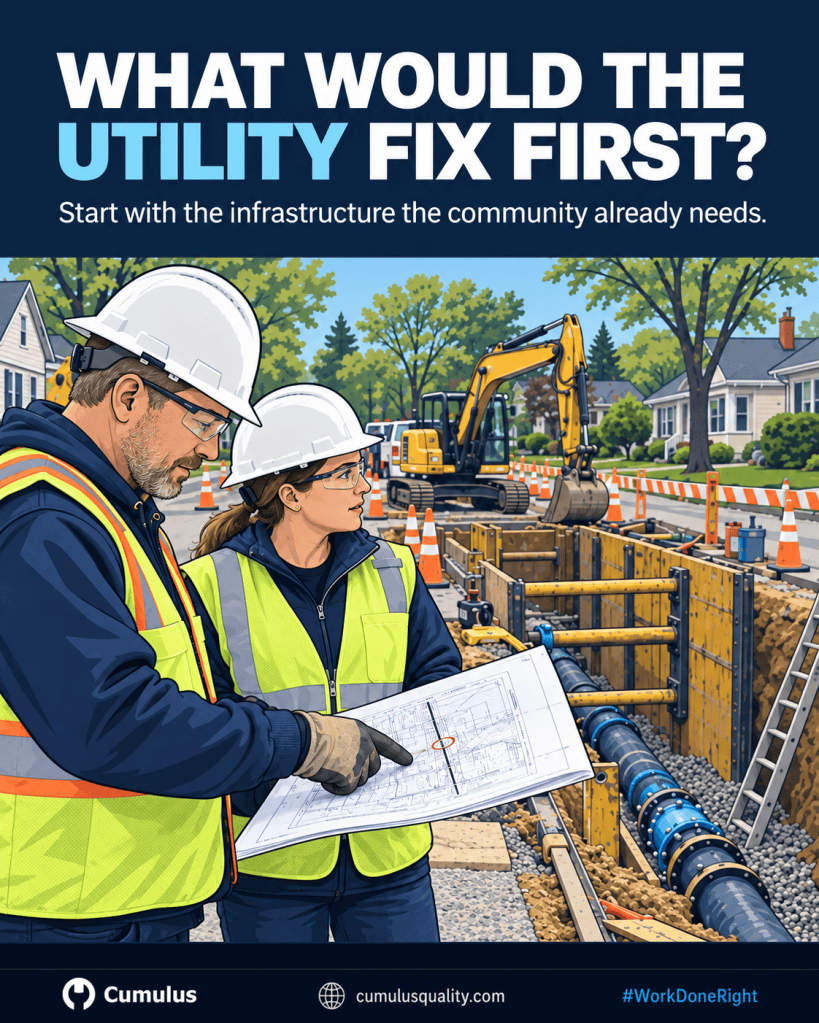

What would you fix first if you had the money and the crew?
If you build data centers and want to earn a community’s trust, that is the question to bring to the local water utility. It works better than a prepared proposal, because the utility already knows the answer. Most utilities carry a list of projects they know they need and cannot fund. The answer is often buried under the street.
Why start with the utility’s list
The funding gap is real and well documented. The American Society of Civil Engineers and the Value of Water Campaign projected that U.S. water infrastructure needs in 2024 would reach $270 billion against $179 billion in spending, a gap of $91 billion for that year alone (Bridging the Gap, 2024). ASCE’s 2025 Report Card estimates about 240,000 water main breaks a year in the United States, and reports that nearly 20% of installed water mains have exceeded their useful lives while they wait for replacement funding.
Those numbers show up locally as a Capital Improvement Plan with deferred items. Communities have put off improvements for years while utilities keep essential service running. When a new development arrives, it can help fund work residents needed long before the project was announced.
Starting with the utility’s list does two things for you. It puts the community’s priorities ahead of yours, which is the fastest way to be treated as a partner instead of an applicant. It also means the project has already been through the utility’s engineering review, so you fund something real.
A recent public example: Colorado City, Texas
On September 14, 2026, Cipher Digital, Fluidstack, and Anthropic committed a combined $10 million to repair and upgrade Colorado City’s water system. The town had faced chronic outages, and in July storm damage at the city’s well pump station left residents without reliable water for days.
According to the companies’ announcement, the city identified the projects, including additional water storage capacity and replacement of aging valves, and the companies agreed to fund them. A newly formed nonprofit, the Colorado City Water Infrastructure Foundation, will manage the funds with the city council, the city manager, and the city’s engineers. The nearby Barber Lake data center runs on its own on-site water supply and draws nothing from the city system, so the added capacity goes to the city.
“Communities that host AI infrastructure should be better off for it,” said Ryan Wilson, Head of Economic Development for Anthropic. “Colorado City’s leaders identified what their water system needs, and we’re glad to help fund it.”
What utilities usually say
Every system is different, and the answers tend to fall into a handful of categories.
Leaking pipes. This is often the first place to look. The utility has already paid to collect, treat, and pump that water, and some of it never reaches a customer. Leak repair recovers water the system already produced, which makes it one of the most direct ways to add usable supply.
Under-reading meters. Customer meters can under-register as they age, recording less water than they deliver. Replacing them recovers revenue for the utility. It does not save water by itself, which matters when you describe the benefit (more on that below).
Storage for steady pressure. Tanks and towers keep pressure stable during peak demand and outages. Colorado City’s list included added storage for exactly this reason.
Failing mains and valves. Breaks interrupt service and waste water. Valve replacement lets crews isolate a break without shutting down a neighborhood.
Treatment upgrades and water reuse. These are larger projects with longer timelines, and they can create new usable supply where the system has none to spare.

How to run the conversation
1. Ask before you propose
Arrive with the question and without a preferred project. Ask what the utility has deferred, what fails most often, and what its staff would do with funding next year.
2. Start with water the community is already losing
If the system has significant losses, leak detection and repair usually offers the most measurable benefit per dollar and the shortest timeline. Ask whether the utility has a recent water loss audit. Some states require them, including Texas, and the audit gives you a starting point for the baseline.
3. Fund the whole job
Leak repair touches several steps: assess losses, find leaks, prioritize repairs with the utility, replace damaged pipe, test the work, and restore the street. A contribution that funds only one step can leave the utility with a half-finished project.
4. Know which benefit you deliver
Repairing a leak keeps water in the system and cuts pumping and treatment costs. Fixing an under-reading meter recovers revenue. Both are part of non-revenue water, and both are worthwhile. Only one of them saves water. Be precise about which one you funded before anyone writes a press release.
5. Agree on ownership and maintenance up front
Who owns the completed infrastructure? Who maintains it? How will results be measured and reported, and for how long? Settle these in writing before construction starts.
Prove the benefit
A completed repair shows that work happened. Only measurement shows how much water it saved.
To show that a project left the system better, you need three things: a baseline measured before construction, each repair tied to a location and an acceptance record, and a measured change after the work is done. An independent party should confirm the result. For leak repair, the measurement usually happens at the zone level: flow and pressure in the repaired area, recorded before and after the work, often within a district metered area or through step testing, and checked against the utility’s production records. System-wide totals move for many reasons, so on their own they can’t isolate the effect of a set of repairs. Without that record, the benefit is an estimate, and estimates are what skeptical residents and regulators push back on.
This is where field records matter. A repair documented at the point of work, with location, test results, and sign-off, is far easier to verify than one reconstructed from invoices months later.
Where Blu Diamond fits
We founded Blu Diamond Water to fund and execute this kind of work. We help companies find projects that local utilities have already prioritized, structure the funding, and deliver the work through our project partner R3 Sustainability. Cumulus provides the workflows and verified field records that document how the work was done. Results are measured against a baseline and confirmed by an independent party, and insurance through our partner Blu Clarity backs delivery of the verified Certificates.
If you plan a facility and want to start the conversation with your local utility, our guide So You Want to Fund a Water Project covers the stakeholders and timelines in more detail.
If you work with a water utility, what project would you put first? Contact Blu Diamond Water to talk through options for your community.
Sources
- American Society of Civil Engineers and Value of Water Campaign, “Bridging the Gap: The Power of Investment in Water,” 2024: https://uswateralliance.org/wp-content/uploads/2024/05/Bridging-the-Gap%E2%80%94The-Economic-Benefits-of-Investing-in-Water.pdf
- American Society of Civil Engineers, 2025 Report Card for America’s Infrastructure, Drinking Water: https://infrastructurereportcard.org/cat-item/drinking-water-infrastructure/
- Texas Water Development Board, Water Loss program: https://www.twdb.texas.gov/conservation/municipal/waterloss/index_waterloss.asp
- Cipher Digital, Fluidstack, and Anthropic, “Cipher Digital, Fluidstack, and Anthropic Commit $10 Million to Repair and Expand Colorado City’s Water System,” GlobeNewswire via Nasdaq, September 14, 2026: https://www.nasdaq.com/press-release/cipher-digital-fluidstack-and-anthropic-commit-10-million-repair-and-expand-colorado