
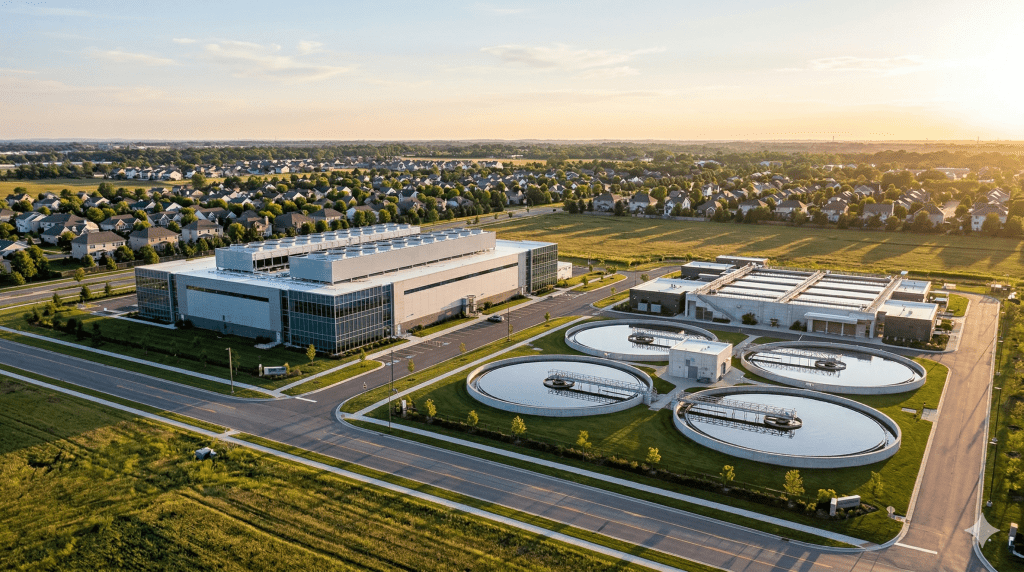
You have a data center going into a community. Maybe you’re through site selection, maybe you’re still evaluating locations. Either way, you’ve seen the headlines: permit delays, council votes gone sideways, neighborhood opposition over water use. You’re now asking yourself a reasonable question: what if we invest directly in the local water system to show that we will be a good neighbor?
Not as a PR exercise or a box to check. As a genuine, long-term investment in the community where you’ll be operating for the next 20 to 30 years.
That’s the right instinct, but water infrastructure is a different world than most developers are used to. It has its own stakeholders, its own funding mechanisms, its own timelines, and its own politics. This post is a practical guide to navigating all of it.
Start With the Right Framing
A community water replenishment project can help ensure the successful development and operation of your 1GW AI data center for less than 0.015 % of your total construction costs.
There are self-interested reasons for a data center developer to fund a water project. Water opposition has killed or delayed projects in Tucson, New Brunswick, Palm Beach County, and elsewhere. Communities that feel their resources are being extracted rather than invested in will push back. That’s entirely rational on their part.
But this isn’t about offsetting your water footprint gallon-for-gallon. It’s about showing up as a long-term partner in a community’s water infrastructure. The projects that go well are the ones where the developer says: We’re going to be using water here. What does your system need? How can we help?
That framing changes the conversation from adversarial to collaborative. It moves you from applicant to partner.
Know What Types of Projects Move the Needle
Not all water projects are created equal, and some are far more practical than others for a developer looking to make a meaningful impact on a reasonable timeline.
Drinking water recovery (leak repair). This is the most accessible starting point. Municipal water systems in the U.S. lose roughly 30% of their treated water to leaks before it reaches a customer. Repairing those leaks doesn’t require new supply, it recovers water that has already been treated and paid for. It’s fast, directly measurable, and communities respond well to it because it addresses waste in their own system. It also has the added benefit of saving energy and reducing carbon emissions because every drop wasted also wasted energy pumping and treating it.
Wastewater reuse. Upgrading treatment infrastructure to produce water suitable for irrigation, industrial processes, or indirect potable reuse. More complex than leak repair, but high-impact and increasingly common across the Sun Belt and water-stressed regions.
Aquifer recharge and groundwater banking. Injecting treated water back into depleted aquifers. Particularly relevant in the Southwest and other regions where groundwater withdrawal exceeds replenishment rates.
Desalination. Brackish groundwater or seawater desalination creates genuinely new supply in water-scarce regions. Higher cost and longer timelines, but it can be transformative where surface water and groundwater options are exhausted.

For a first project, particularly one intended to build community trust alongside your development timeline, drinking water recovery and wastewater reuse are typically the strongest candidates. They’re well-understood, lower-risk, and can deliver measurable results within 12 to 18 months of construction start.
The Stakeholders You Need to Engage
Water infrastructure doesn’t happen in isolation. You’ll be working across a web of stakeholders, and overlooking any one of them can stall a project for months.
The local water utility. This is the most important relationship you’ll build. The utility owns and operates the system you’re looking to improve. Without their participation, nothing moves forward. The good news: most utilities are chronically capital-constrained. They maintain a backlog of projects they know are necessary but lack the funding to execute. If you approach with capital and a willingness to support their priorities — rather than a desire to direct them — you’ll generally find a receptive partner.
Municipal and county government. City managers, council members, and county commissioners are the political layer. They care about constituent impact, rate affordability, and not being the elected official who approved a facility that strained the town’s water supply. They need to be able to communicate to voters how this development benefited the community.
State and federal water agencies and regulators. Depending on the jurisdiction, you may need permits or approvals from agencies overseeing water allocation, environmental review, or groundwater management. Water projects may also be subject to federal regulations administered by the U.S. Environmental Protection Agency and others. Engage early — don’t treat regulatory coordination as a downstream task.
Community organizations and residents. The people who live in the community are not a stakeholder to be “managed.” They’re the reason the water system exists. Engage them early, be transparent about your plans and motivations, and don’t overpromise.

How to Work With the Utility
This is where many developers make mistakes. The instinct is to show up with a check and a project in mind. Utilities don’t work that way.
Start by understanding the utility’s Capital Improvement Plan. Every utility maintains a prioritized list of projects spanning the next 5 to 20 years, shaped by system condition, regulatory requirements, and available funding. Ask what has been deferred due to budget constraints. Ask what their most pressing operational challenges are.
Don’t arrive with a solution. Arrive with a question: What does your system need most?
Once you’ve identified a project that aligns with both the utility’s priorities and your development timeline, you’ll need to work through the operational arrangement. Key questions include: Who owns the completed infrastructure? Who operates and maintains it long-term? How are outcomes measured and reported? What happens after the initial investment period?
These aren’t difficult questions, but they need to be resolved upfront. A well-structured partnership agreement protects both parties and gives the utility confidence that this is a durable commitment, not a one-time donation.
Government Relations: Move Deliberately
If you’re building a large facility, you likely have a government affairs team already. Direct them toward water specifically. It’s an issue likely to determine whether your project gets community support or community opposition.
The most effective approach is usually to begin with local industry associations or economic development organizations. They understand the political landscape, know who is receptive, and can make introductions to utility leadership and elected officials. Approaching a city council cold is rarely productive.
Frame every conversation around shared benefit. You’re not asking the community for something. You’re offering to invest in their infrastructure. That is a fundamentally different dynamic than a permitting negotiation, and it should be treated accordingly.
One important consideration: many municipalities are managing multiple large industrial water users, not just yours. A project that benefits the entire system is far more compelling than one that only addresses your facility’s permit conditions. A water recovery program that reduces system-wide losses helps every ratepayer in the community — and that’s a story elected officials want to tell.
Funding and Financing: More Options Than You Might Expect
This is where the conversation gets practical, because you don’t necessarily need to fund the entire project from your own balance sheet.
Direct capital contribution. The simplest structure. You fund the project directly, the utility builds or repairs the infrastructure. Clean, fast, and straightforward to communicate to a city council. The limitation: it’s all upfront capital with no structured outcome you can point to in a sustainability disclosure.
Public-private cost sharing. Many water projects are partially funded through federal or state programs, such as EPA’s State Revolving Fund, USDA Water & Waste Disposal grants, WIFIA loans, and similar mechanisms. Your investment can fill the gap that public funding doesn’t cover, stretching both sets of dollars further. This approach works particularly well for larger projects where multiple funding sources are standard.
Structured certificate financing. This is the approach Blu Diamond was built around, and it addresses a structural problem that has held back water infrastructure investment for decades.
Most water projects struggle to attract private financing because the economics don’t work without committed upfront capital. Utilities can’t raise rates enough to cover the debt service, federal grants are competitive and slow, and private investors need a return mechanism that traditional water contracts rarely provide.
Blu Diamond’s model solves this through a certificate offtake structure. Here’s how it works: the data center operator commits to purchasing Blu Diamond Water Certificates over a 5- to 10-year term. That committed offtake agreement enables Blu Diamond’s financial partners to provide the upfront capital the project needs to break ground before a single pipe is laid. Investment-grade insurance underwrites project performance, which is what makes the entire structure bankable. The insurer takes on the delivery risk, giving the financial partners confidence to deploy capital and giving the operator confidence that the certificates they’re purchasing represent real, verified outcomes.
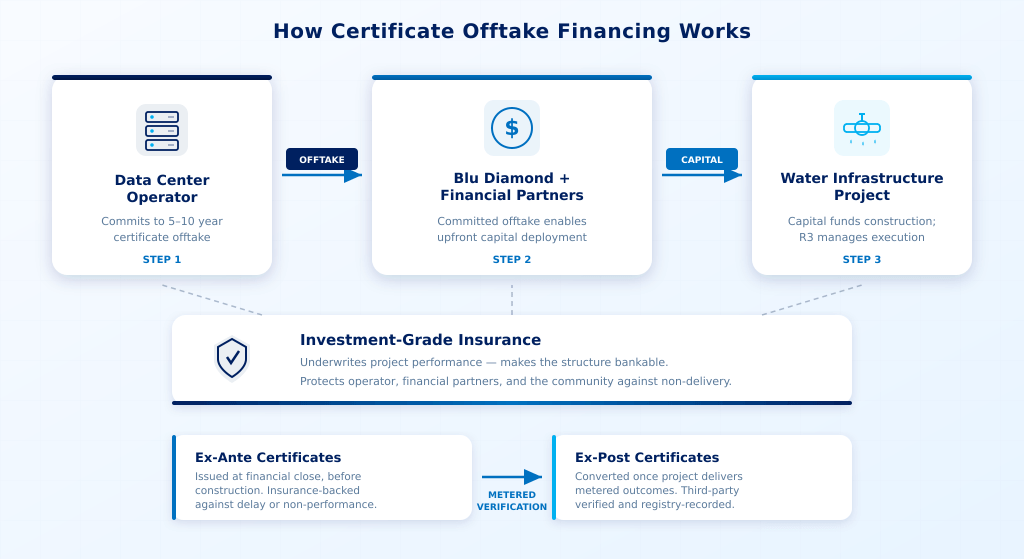
Pre-commissioning certificates (Ex-Ante) are issued at financial close, backed by insurance against delay or non-performance. Once the project is operational and producing metered water savings, those certificates convert to Ex-Post certificates supported by continuous monitoring data and third-party verification. The result is a structured, auditable water stewardship credential — not a donation receipt.
For a data center operator, this means you don’t carry the full capital burden of the project. Your offtake commitment unlocks third-party financing. You receive verified, insurance-backed certificates that hold up in investor calls, sustainability reports, and regulatory proceedings. And the community gets infrastructure it needs, funded without rate increases.
What Blu Diamond Brings to the Table
Blu Diamond operates at the intersection of the developer and the utility. We understand what utilities need to say yes to a partnership, and we understand what developers need to make the investment defensible to their board, their investors, and their communities.
Three specific areas where we add value:
Project identification and qualification. We maintain a portfolio of over 60 qualified water projects across 15 states, and we can identify and evaluate new projects in any watershed where you operate. Every project is assessed against the Blu Diamond Water Standard for additionality, measurability, and geographic relevance to the buyer’s operations.
Structured financing. Through the certificate offtake structure described above, we work with our financial partners to assemble the capital stack so the project actually gets built. This is structured finance — real instruments, insurance backing, and a transparent registry — not philanthropy.
Project development and execution. Our partner R3 Sustainability develops and manages water infrastructure projects globally. R3 handles engineering oversight, construction management, and operational handoff, so neither the developer nor the utility needs to become a water infrastructure project manager.
Timeline Expectations
Water projects take time. Less time than building new supply from scratch, but more time than most developers initially expect. A realistic timeline looks roughly like this:
Months 1–3: Stakeholder engagement. Meet with the utility, review their Capital Improvement Plan, identify candidate projects, build relationships with local government and community organizations.
Months 3–6: Project scoping and structuring. Engineering assessment, cost estimation, partnership agreement, certificate offtake or funding arrangement.
Months 6–12: Permitting and procurement. Environmental review if required, contractor selection, financing close.
Months 12–24+: Construction and commissioning. For water recovery projects, this can move toward the shorter end of the range. For reuse or desalination, plan for the longer end.
Commissioning onward: Operations and verification. Continuous metering, third-party audits, certificate conversion from Ex-Ante to Ex-Post, and ongoing retirement against your water footprint.
The critical point: if you wait until you’re deep in your own permitting process to start thinking about water, you’re already behind. The best time to begin is during site selection or early development, when you still have leverage to shape the conversation. The second-best time is now.

The Bigger Picture
Data centers are going to continue getting built. The compute demand is real and accelerating. The question is whether that growth happens in partnership with local communities or over their objections.
Water is the most tangible, most visible, and most emotionally resonant resource in any community. Water comes out of faucets. People drink it. Their children drink it. When residents hear that a new facility will consume a million gallons a day, the reaction is visceral.
Investing in water infrastructure helps developers build durable trust with host communities. Not because it satisfies a sustainability requirement, but because it demonstrates an understanding of what matters to the people who live there.
You don’t have to do this alone, and you don’t have to figure it out from scratch. But you do have to start.
Questions about funding a water project in your community? Contact Blu Diamond Water.