
WRI Aqueduct, the WWF Water Risk Filter, and the Blu Diamond Water Risk Calculator each answer a different question. Here’s how to know which one you need.

If you’ve started thinking seriously about water risk, you’ve probably encountered at least one of the major tools available for assessing it. WRI’s Aqueduct Water Risk Atlas and the WWF Water Risk Filter are the two most widely used platforms in the space. Both are free, both are backed by serious research institutions, and both are genuinely useful. But they were built for different purposes, and understanding what each one does, and doesn’t do, can save you a lot of time.
This isn’t a ranking. It’s a guide to using the right tool for the right job.
WRI Aqueduct: Best for Global Portfolio Screening
The WRI Aqueduct Water Risk Atlas is the most widely recognized water risk tool in the world, used by major corporations, governments, and financial institutions to understand water stress patterns across geographies. The latest version, Aqueduct 4.0, draws on peer-reviewed hydrological models to map water risk indicators at the catchment level globally, with projections out to 2080 under multiple climate scenarios.
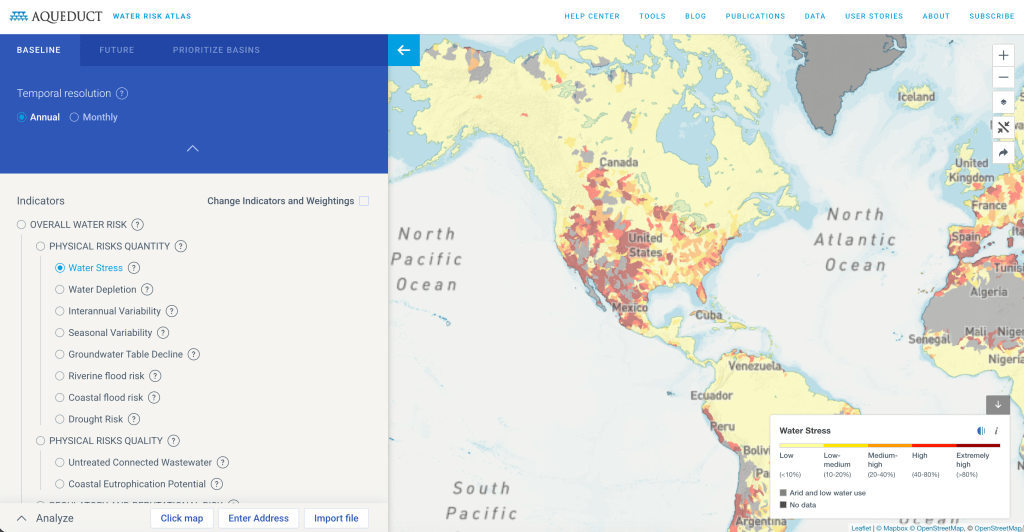
Aqueduct is excellent at one specific thing: helping large organizations identify which of their many global sites or supply chain locations face the highest water stress. If you have operations in 40 countries and need to prioritize where to dig deeper, Aqueduct is the right starting point.
Its limitations are real and openly documented by WRI. The tool is designed for global screening, not local analysis. WRI explicitly encourages users to supplement Aqueduct data with local sources for any specific site where they’re making consequential decisions. The underlying models are updated every four to five years, so the data doesn’t reflect rapidly shifting conditions. And the tool doesn’t include cost escalation trajectories, infrastructure vulnerability scoring, regulatory trend analysis, or scenario planning at the individual facility level.
WWF Water Risk Filter: Best for Supply Chain Prioritization
The WWF Water Risk Filter combines 42 basin-level indicators across three risk types, physical, regulatory, and reputational, with operational risk assessment based on how individual sites depend on and impact water. It’s been used by more than 2,000 companies to map over 50,000 sites in global supply chains.
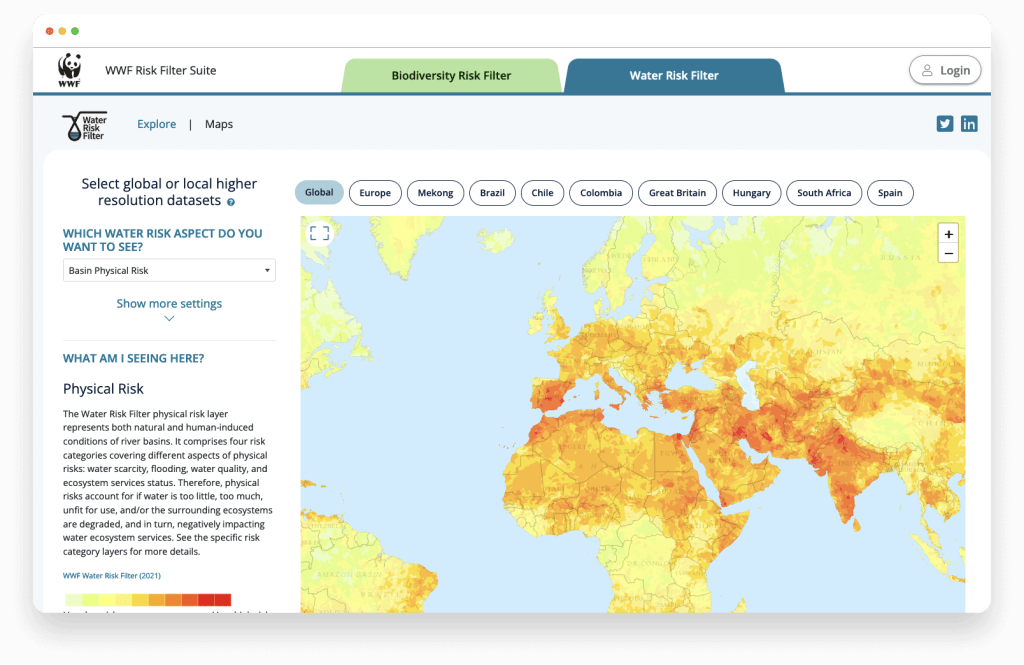
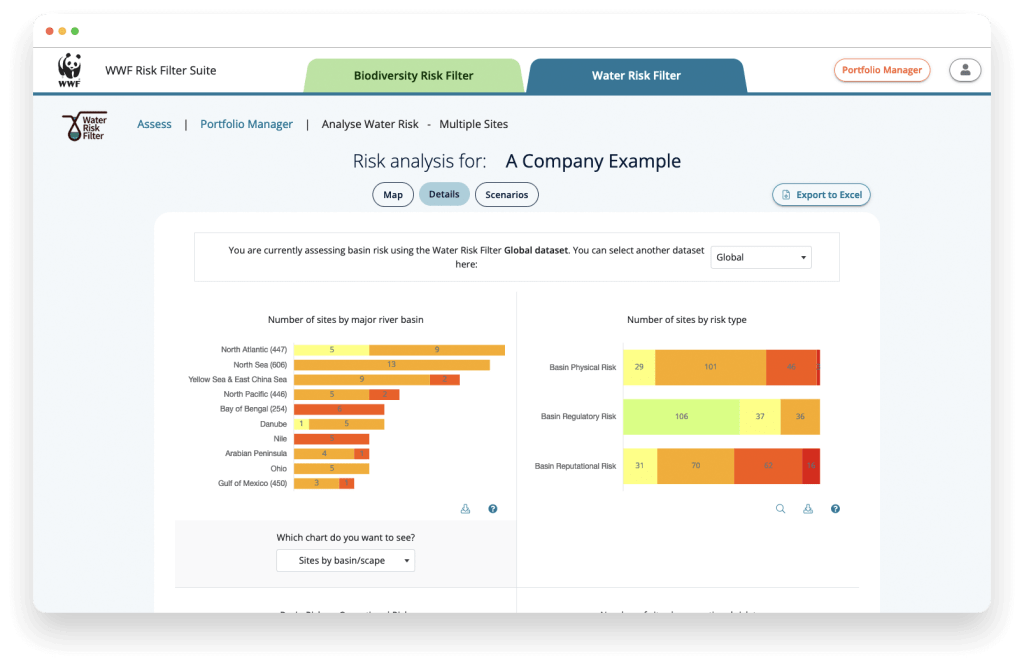
The WWF tool is particularly strong for companies that need to understand reputational and regulatory exposure alongside physical scarcity, and for organizations subject to EU sustainability reporting requirements under CSRD, TNFD, or similar frameworks.
The tradeoffs: you need to register and upload site data to run a full assessment. Like Aqueduct, it’s optimized for portfolio-level screening rather than deep local analysis. And it doesn’t include the financial dimensions of water risk — cost escalation, infrastructure investment gaps, or local water pricing trajectories.
Both Aqueduct and the WWF Water Risk Filter are excellent research-grade tools for enterprise portfolio screening. Where they’re less suited is facility-level operational decision-making, particularly for U.S.-based operators who need current, financially grounded risk information tied to a specific location.
Blu Diamond Water Risk Calculator: Built for Facility-Level Decisions
The Blu Diamond Water Risk Calculator was built to answer a different question: not ‘which of my global sites should I prioritize,’ but ‘what is the specific water risk profile of this facility, and what should I do about it.’
The tool scores five risk dimensions at the ZIP code level, pulling real-time data from the EPA, USGS, US Drought Monitor, Census Bureau, and NOAA:
• Physical scarcity: current and projected water availability relative to demand in your watershed
• Cost escalation: trajectory of water and wastewater rates in your region, a financially material risk that most other tools omit
• Contamination exposure: regulatory and water quality risk from your local system
• Infrastructure vulnerability: age, condition, and investment gap of the water infrastructure your facility depends on
• Climate trajectory: long-term supply outlook under regional climate projections
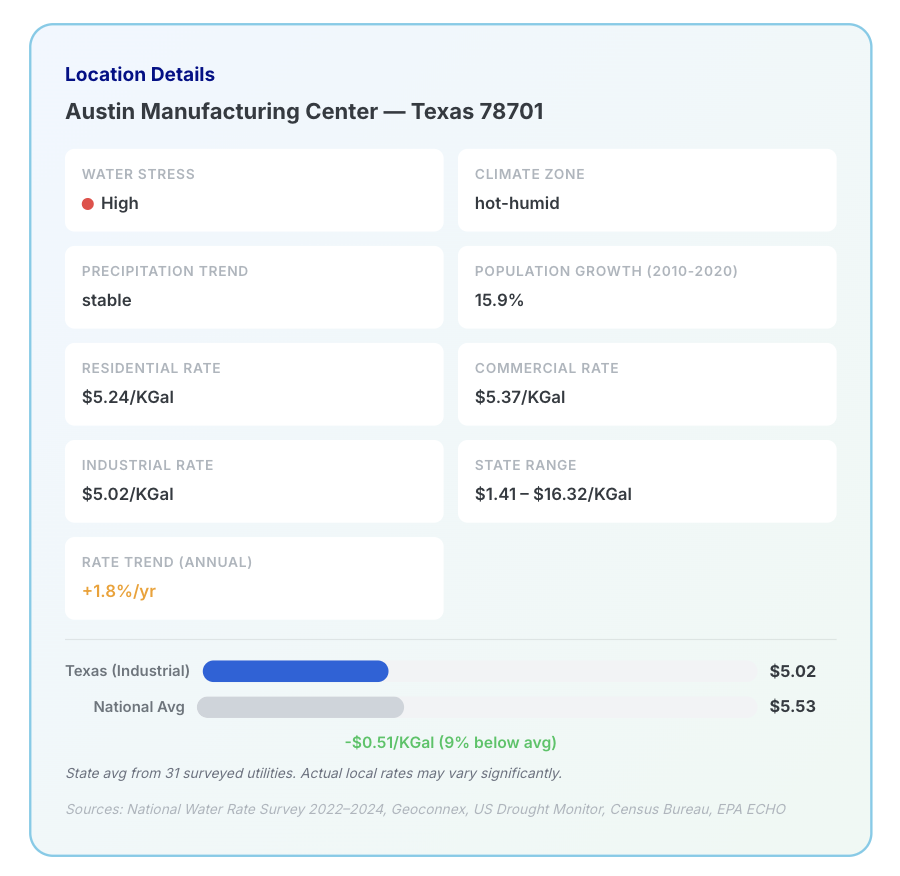
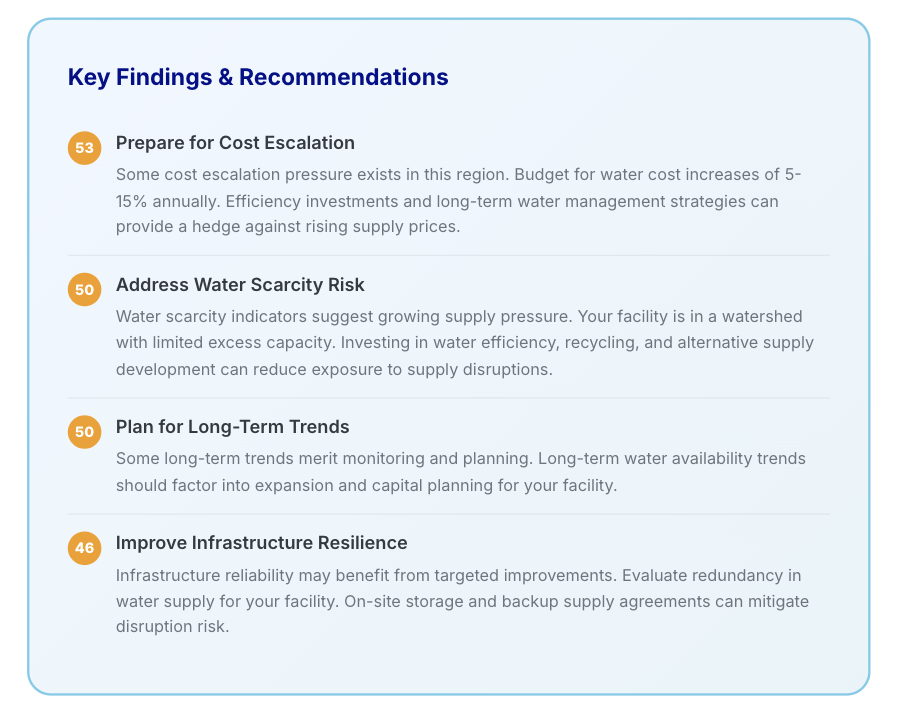
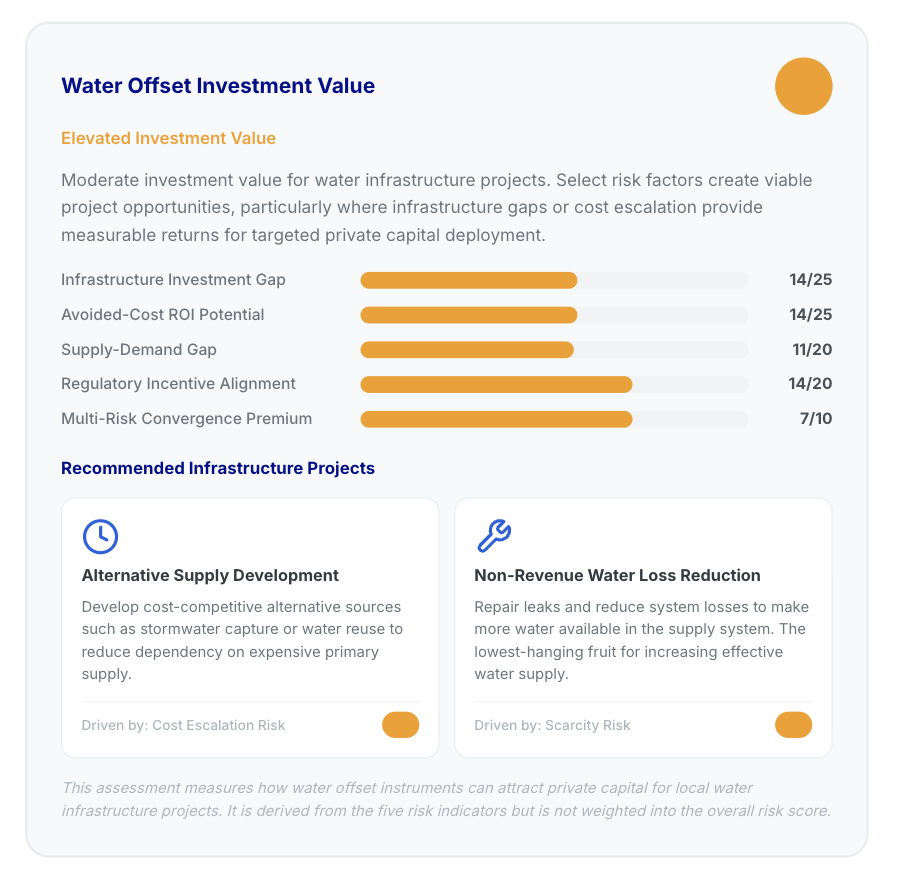
The scenario planning feature is what sets it apart from the screening tools. You can model how your risk score changes if a new major industrial user comes into your watershed, if drought conditions worsen, or if a significant infrastructure upgrade is completed. Most risk tools tell you where you stand. This one helps you think through where you’re going.
The tool is tailored by user type, with different risk weightings and recommendations for municipalities, industrial and commercial operators, insurers, and lenders. And it connects directly to action: after running your assessment, you can request a detailed report and learn how Blu Diamond Water Certificates can help mitigate the risks your score identifies.
Its scope is currently U.S.-focused. For global portfolio work, Aqueduct or the WWF filter remain the better tools. For North American operational risk with financial depth and scenario planning, the Blu Diamond calculator is built for that job.
Which Tool Should You Use?
These tools are complementary, not competing. A simple framework:
• Global site screening across many locations: WRI Aqueduct or WWF Water Risk Filter
• Supply chain risk tied to EU regulatory reporting frameworks: WWF Water Risk Filter
• Facility-level operational risk in the U.S.: Blu Diamond Water Risk Calculator
• Financial risk modeling: cost trajectory, infrastructure gap, scenario planning: Blu Diamond Water Risk Calculator
• Connecting risk assessment to an actionable mitigation strategy: Blu Diamond Water Risk Calculator
Many sustainability teams use Aqueduct or WWF’s filter first to identify priority sites, then run the Blu Diamond calculator for U.S. locations that warrant deeper analysis. That layered approach gets you the best of each tool’s strengths.
Run the Blu Diamond Water Risk Calculator at bludiamondwater.com/water-risk. It takes about two minutes, requires no registration, and ends with tailored recommendations for your facility.