

Every major infrastructure project needs two kinds of permission.
The first is the technical and legal kind: land, power, fiber, permits, water, financing, and a design that can actually be built.
The second is harder to put on a checklist. It is the community’s belief that the project belongs there and that the people who live nearby will share in its benefits.
People sometimes call that a social license to operate. I think of it more simply as a community credit.
A community credit is a tangible, long-term benefit that a project leaves behind for the place hosting it. It might be a water system upgrade, a public park, a new fire station, funding for schools, or another investment the community has identified as a real priority.
It is not a donation made after the permits are secured. It is not a glossy sustainability campaign. And it is definitely not a payment for silence.
Done well, it is part of the project from the beginning.
Why technically sound projects still run into opposition
Data center developers are good at technical diligence. Before committing to a site, teams evaluate power availability, fiber connectivity, land, zoning, constructability, cooling options, water availability, and dozens of other variables.
But community support is sometimes treated as a communications task that begins after the major decisions have already been made. By then, residents may be hearing about the project for the first time while the developer has been working on it for months or years.
That imbalance creates suspicion. Residents see a large industrial facility asking for access to local land, power, and possibly water. They hear about construction traffic, noise, transmission lines, backup generators, and tax incentives. The benefits may sound abstract or uncertain, while the impacts feel immediate and local.
The concern is not irrational. Data centers vary enormously in size, design, and impact. For example, a Virginia legislative study found that most facilities in the state used about the same amount of water as, or less than, a large office building, while a smaller number used substantially more. At six utilities studied, data centers represented anywhere from 0.2% to 21% of total water use.
That range is the point. A national average cannot tell a community what a particular project will mean for its water system. The cooling design, local climate, source of supply, utility capacity, competing demand, and drought risk all matter.
The same is true for power, noise, land use, and tax revenue. Communities want project-specific answers.
A community credit is more than mitigation
Every responsible developer should mitigate the direct impacts of its project. That means following zoning and environmental requirements, controlling noise and light, managing construction traffic, and designing the facility to use power and water efficiently.
But mitigation only gets a project back toward neutral. A community credit asks a different question:
If this facility operates here for the next 20 or 30 years, what will be meaningfully better because it came?
That question changes the conversation. Instead of asking residents to accept a project because its impacts will be managed, the developer begins looking for a shared investment that the community will still value years later.
Sometimes that investment should involve water. Sometimes it should not. The point is to start with what the community actually needs, not with the benefit the developer finds easiest to announce.
Why water can be a powerful community credit
Water is unusually tangible. Everyone relies on it, the infrastructure is local, and the benefits of a good project can extend far beyond the walls of a data center.
Many utilities already have capital improvement plans filled with necessary work that has been delayed because funding is limited. The project may involve repairing leaking distribution pipes, expanding wastewater reuse, upgrading treatment, restoring an aquifer, or developing a new source of supply.
The need is large. A 2025 Government Accountability Office review found that local governments and utilities carry most of the cost of repairing and upgrading drinking water and wastewater systems, generally through customer rates. Federal programs provide important grants and loans, but communities still face financial and administrative barriers.
An industrial development can help close that gap.
The best water investments do two things at once. They make the community’s system more resilient, and they strengthen the conditions that allow responsible economic development to continue.
That is a much better outcome than arguing over whether a facility’s water use looks large or small on a national chart.
The four tests of a credible community credit
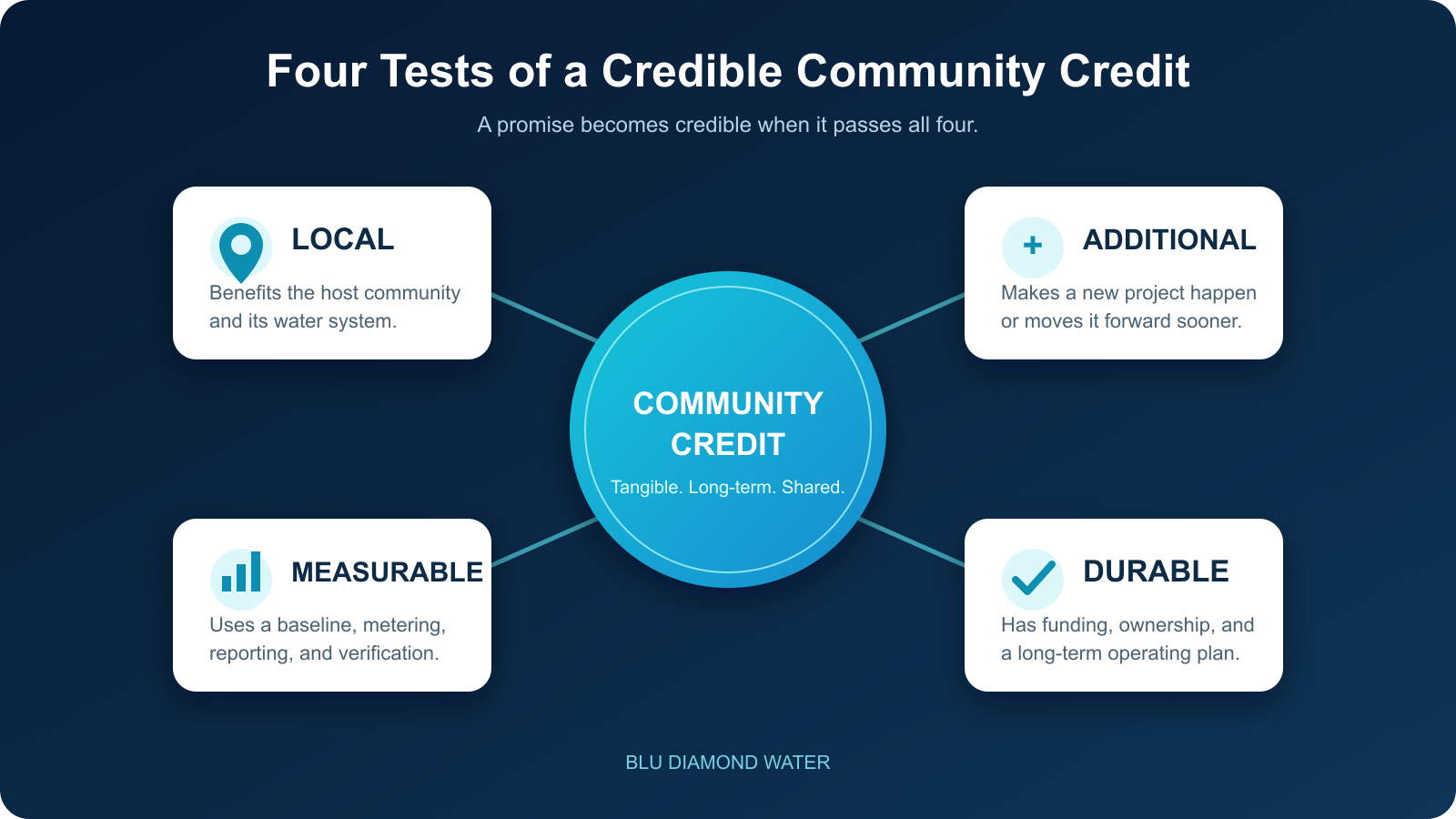
A credible community credit should pass four tests.
1. Local
The benefit should reach the people and water system connected to the project. A distant restoration project may have environmental value, but it will not answer a host community’s concern about its own pipes, aquifer, treatment plant, or water rates.
For water projects, that usually means working within the same watershed, utility service area, or other hydrologically relevant geography.
2. Additional
The investment should cause something new to happen or allow a planned project to happen sooner or at a larger scale.
Funding a project that was already fully financed and scheduled may create a certificate or a press release, but it does not create much additional community value. The strongest projects are the ones sitting in a utility’s capital plan because the need is clear and the money is not.
3. Measurable
The promised result needs a baseline, a measurement method, and ongoing reporting.
If the project repairs leaks, how much treated water is actually being recovered? If it expands reuse, how much potable demand is avoided? Who verifies the result, and what happens if performance falls short?
Credibility comes from measured outcomes, not modeled intentions.
4. Durable
The benefit should outlast the announcement.
That requires clarity about ownership, operations, maintenance, and long-term funding. A new asset that the utility cannot afford to operate is not a gift. It is a future liability.
The structure should protect the community after the developer’s ribbon-cutting team has gone home.
How to build the community credit into development
The process does not need to be complicated, but it needs to start early.
Start during site selection
Community priorities should be part of site diligence, alongside power, fiber, land, water availability, and permitting. Waiting until a rezoning hearing to begin the conversation puts everyone in a defensive position.
Early engagement also gives the developer time to identify a credible project, structure funding, complete engineering, and align the water project with the data center’s own development schedule.
Ask before proposing
Start with the local utility’s capital improvement plan. Ask what has been deferred, where the system is most vulnerable, and which projects would create the greatest public benefit.
Then listen to local government, residents, community organizations, and large water users. The goal is not to test a finished message. It is to understand the place well enough to shape the investment.
This lesson shows up well beyond data centers. A Department of Energy case study on public charging infrastructure found that a team initially treated site selection as a technical exercise, then changed its approach after community engagement led it to better locations and stronger local relationships.
Put the commitment in writing
A credible plan should identify the project, funding source, schedule, responsible parties, expected outcomes, measurement approach, and long-term operating responsibilities.
Depending on the circumstances, that commitment might sit in a development agreement, a utility partnership, a community benefits agreement, or a separate project and financing contract. The legal form will vary. The specificity should not.
A useful industry comparison: Community Benefits Agreements. The closest established analogue to a community credit may be a Community Benefits Agreement, or CBA. The U.S. Department of Energy describes a CBA as a legally binding, negotiated agreement between a developer and a community, often represented by a coalition of community groups, that identifies benefits the community will receive in exchange for supporting or not opposing a project. DOE notes that CBAs are increasingly used for large energy projects because they give communities a way to shape the benefits while helping developers reduce permitting and approval risk.
The concepts overlap, but they are not identical. A community credit is the broader principle that a major project should leave its host community better off. A CBA is one possible legal mechanism for turning that principle into enforceable commitments. A water-system investment could be included in a CBA, a development agreement, or another structure. Whatever the vehicle, the benefit should still be locally chosen, additional, measurable, and durable.
Report what actually happened
The developer should publish progress through construction and operations, including delays or underperformance. Communities are more likely to trust a project that acknowledges problems and explains the corrective plan than one that disappears after the groundbreaking.
What does not work
Some approaches can make skepticism worse.
Arriving with a finished solution. The utility and community understand their system better than the developer does. A preselected project can feel like another decision made without them.
Using a distant project to answer a local concern. Portfolio-level water stewardship matters, but it is not a substitute for addressing conditions where the facility operates.
Making vague promises. Commitments to be a “good neighbor” or “water positive” mean little without a defined geography, timeline, baseline, and measurement method.
Treating the investment as public relations. If the announcement is more developed than the operating plan, residents will notice.
Overpromising. No project has zero impact. Trust starts with a candid explanation of the tradeoffs and what the developer can realistically improve.
Where Blu Diamond fits
Blu Diamond helps connect industrial water users with locally relevant water infrastructure projects and the utilities that need them.
We evaluate projects for additionality, measurability, and geographic relevance. We then structure certificate offtake commitments that can help unlock upfront financing, with insurance and verification built into the model. That allows a company to make a multi-year commitment while the water project gets the capital it needs to move forward now.
The details matter, and we have explained the financing structure more fully in How Blu Diamond Accelerates Financing for Water Infrastructure Before It’s Built.
The larger idea is simple: a community credit should not depend on goodwill alone. It should be structured, funded, measured, and built to last.
The bottom line
Data centers are essential infrastructure. Communities also have every right to ask what they are getting in return for hosting them.
Developers that wait until opposition forms will spend their time defending a project. Developers that engage early can help shape something better: a facility that gets built, infrastructure that gets funded, and a host community that is stronger because the project came.
That is the community credit.
And every major infrastructure project should earn one.
Is your company evaluating a data center site or looking for a credible water investment in an existing host community? Contact Blu Diamond Water to explore locally relevant projects and financing options.
This article is a companion to Matthew Kleiman’s LinkedIn data center explainer series. Read the original Community Credit post on LinkedIn.