

Somewhere right now, a landowner is getting a call from a data center developer, and the number being discussed is several times what the property was worth a few years ago.
Maybe you own a large parcel near a transmission line. The highway is close. The land looks flat. You have read stories about communities attracting billions of dollars in data center investment and wondered: Could that be my land?
Maybe. But acreage and nearby power lines are only the beginning.
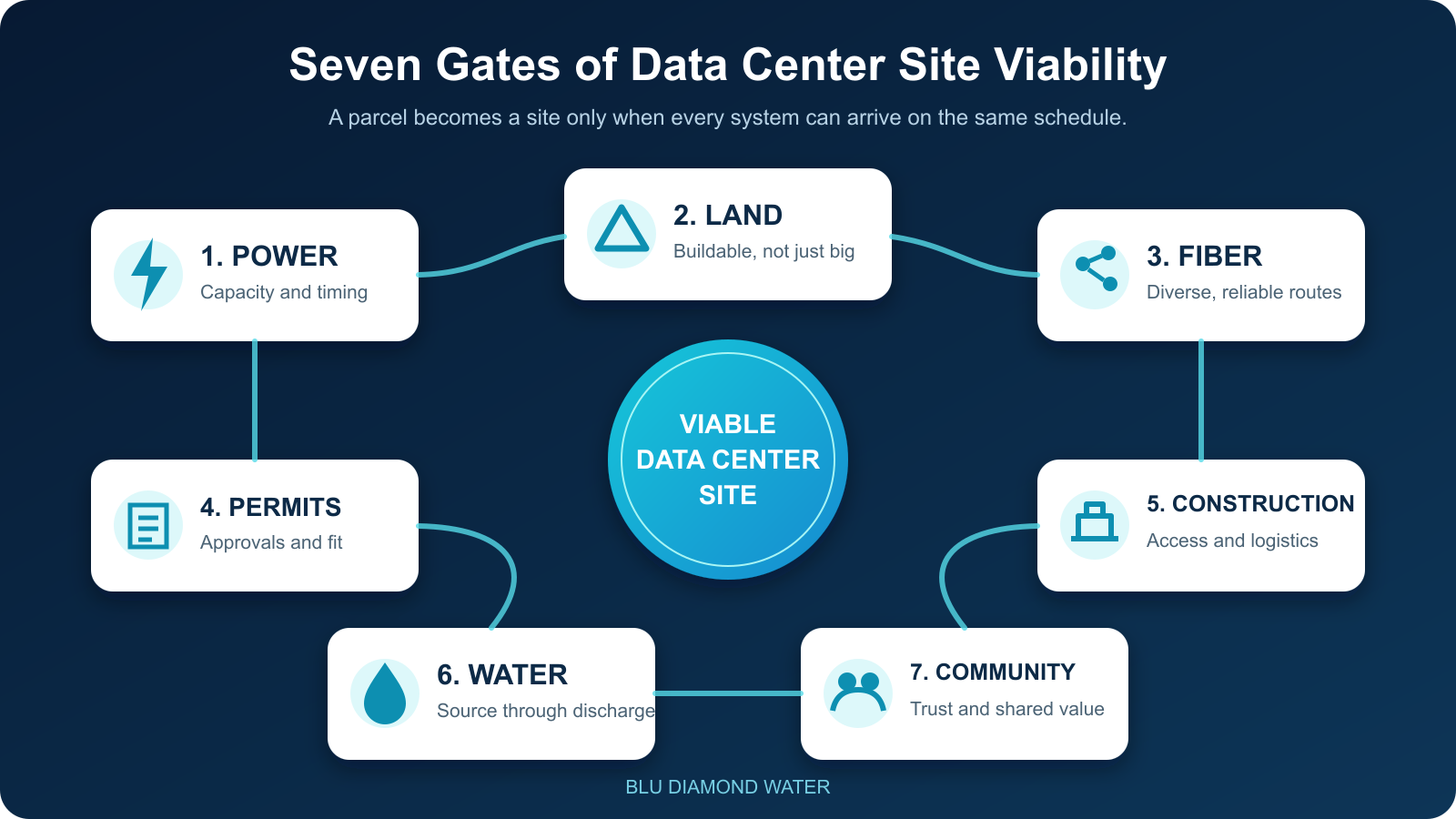
A data center site is not just a piece of real estate. It is the place where several infrastructure systems have to meet on the same schedule: power, fiber, transportation, water, wastewater, permitting, construction logistics, and community support. A parcel can look perfect on a map and still fail in diligence because one of those systems cannot keep up.
That is why “data center land” is usually better understood as land with data center potential until a developer has answered a series of gating questions.
1. Can the site actually get enough power—and when?
The transmission line in the distance may be encouraging, but proximity does not establish that capacity is available.
The utility may need a new substation, transmission upgrades, new generation, or years of system work before it can energize the site. The line may already be constrained. The required interconnection studies may not be complete. The date that matters is not when a line appears on a map; it is when the utility can commit to delivering the required power.
Virginia’s Joint Legislative Audit and Review Commission found that access to power and large, flat areas of land are key data center requirements. It also noted that utilities may have to delay large-load additions until adequate generation and transmission capacity exists. That makes power delivery a schedule question, not merely a location question. (JLARC)
Questions to ask:
- Which utility serves the property?
- How much capacity could it deliver?
- What studies, upgrades, and agreements would be required?
- Is the energization date firm enough to support development?
2. Is the land physically workable?
Size matters, but gross acreage can be misleading. Developers care about the acreage that remains usable after accounting for shape, topography, wetlands, floodplains, streams, setbacks, easements, access roads, stormwater controls, substations, generators, cooling equipment, and future phases.
A long, narrow parcel may be harder to use than a smaller rectangular one. A property that requires extensive grading or soil improvement may carry a large cost and schedule penalty. Environmental constraints can reduce the buildable area or create mitigation and permitting obligations.
The right early question is not “How many acres do I own?” It is “How many contiguous, developable acres remain after the real constraints are mapped?”
3. Can the facility connect to the digital world?
Data centers do not need ordinary commercial broadband. They need access to major fiber routes, typically with multiple independent paths so that a single cut or failure does not isolate the facility.
Distance matters, but so do route diversity, provider availability, construction rights, easements, and the cost and schedule to extend fiber into the site. A parcel can sit near a fiber route yet still require a difficult or expensive connection.
This is another reason a map-level review is only a first screen. The developer eventually needs confirmation from the providers that will build and operate the connections.
4. Can the project be permitted—and should it be built there?
Zoning is only one part of the answer. A project may also require environmental review, air permits for backup generation, water and wastewater approvals, stormwater permits, road work, utility easements, and local legislative approvals.
Local compatibility matters too. Data centers are industrial facilities. Their size, generators, cooling equipment, electrical infrastructure, lighting, and continuous operation can create concerns when placed close to homes or sensitive resources.
JLARC found that some Virginia localities experienced residential impacts after permitting data centers near neighborhoods, while others have strengthened planning and zoning requirements. The lesson is broader than Virginia: a site is more durable when land-use compatibility is addressed early rather than treated as a communications problem after the design is largely fixed. (JLARC)
5. Can it actually be built?
A promising site still has to support one of the most demanding construction programs in the commercial market.
Transformers, generators, switchgear, chillers, modular electrical rooms, and other oversized equipment must physically reach the property. Heavy-haul routes, bridge clearances, staging areas, crane access, contractor capacity, workforce availability, lodging, and nearby material supply all affect the construction plan.
Road access that is perfectly adequate for current agricultural or light-industrial use may not be adequate for years of concentrated heavy construction. Required transportation upgrades can become another schedule, permitting, and financing project of their own.
6. Can it be cooled and operated responsibly?
This is where water moves from a utility line on a map to a full site-development question.
Not every data center uses the same cooling system or the same amount of water. Some facilities use very little direct water; others rely on evaporative systems that consume more, especially during hot weather. The answer depends on computing density, climate, cooling design, operating strategy, and the water available around the site.
For a water-dependent design, diligence should cover at least six issues:
- Supply: Is there a reliable potable, raw, reclaimed, or other appropriate source?
- Capacity: Can the utility meet both average demand and peak-day demand without compromising existing customers?
- Conveyance: Are the mains, pumps, storage, and pressure adequate, or will new infrastructure be required?
- Quality: Is the water chemistry suitable for the cooling system, and what treatment will be needed?
- Discharge: Where will blowdown or other wastewater go, and can the receiving system handle its volume and chemistry?
- Resilience: How will the project operate during droughts, restrictions, outages, or other stressed conditions?
The Department of Energy notes that water consumption in cooling-tower data centers is tied to IT heat load and the efficiency of each step used to remove that heat. (DOE)
The City of Quincy, Washington, offers a useful example of why these questions belong in early site planning. The city and Microsoft developed a specialized reuse utility to treat and recirculate data center cooling water, reducing reliance on potable groundwater. The system is successful, but it took about a decade to plan, design, construct, and test. EPA’s case study also notes that data centers located too far from the reuse system face different connection economics. (EPA)
That is the practical point: a promising water solution does not help the critical path unless its source, treatment, permits, pipes, financing, and construction can all be delivered in time.
7. Will the community support it?
Jobs, investment, and tax revenue matter. So do the questions residents will ask about noise, traffic, power infrastructure, water, environmental effects, and what the project leaves behind for the people who host it.
Community support is not a box to check after a site has been selected. It is part of site viability.
The strongest projects engage while the design can still change. They share credible estimates, identify local concerns, and look for investments that address real community priorities. Water infrastructure can be especially valuable because a well-designed project may improve resilience, expand capacity, accelerate reuse, or reduce pressure on potable supplies.
EPA notes that properly treated recycled water can support data center cooling while reducing strain on local water supplies. (EPA) The opportunity, however, has to be designed for the particular community and water system. There is no universal solution.
What happens if a developer calls?
The first document may not be a purchase agreement. It is often an option agreement that gives the developer time to investigate the site and the right to buy it later if the project moves forward.
That period may last months or years because power, permits, environmental conditions, infrastructure, and commercial demand all need to be confirmed. Some options are extended. Some are never exercised.
Landowners should involve experienced legal, tax, and real-estate advisers before signing anything. The price matters, but so do the option period, extension rights, payments, access for testing, restoration obligations, assignment rights, confidentiality, closing conditions, and what happens if the developer walks away.
An option is evidence of interest. It is not proof that the parcel has become a viable data center site.
A practical first-screen checklist
Before assuming a property carries a data center premium, try to answer these questions:
- Who controls the property, and are the title and boundaries clear?
- How many contiguous acres are genuinely developable?
- What wetlands, flood, habitat, historic, soil, or topographic constraints exist?
- Which electric utility serves the site, and what has it said about capacity and timing?
- Which fiber providers and diverse routes are realistically available?
- What zoning and discretionary approvals would be required?
- Can heavy equipment reach and stage on the site?
- What cooling approach is plausible for the climate and intended computing load?
- What water source, treatment, conveyance, discharge, and reuse infrastructure would that approach require?
- How would the project affect nearby residents and existing utility customers?
- Which infrastructure upgrades must be built, who would own them, and who would pay?
- Can power, water, permits, fiber, and construction all arrive on the same schedule?
If several answers are still “unknown,” that is normal. The purpose of early diligence is to identify which uncertainties can be resolved and which ones could stop the project.
Where Blu Diamond fits
Blu Diamond Water helps companies and communities evaluate water-related opportunities and structure investments in water-saving and water-supply infrastructure.
For a potential data center site, that can mean looking beyond a nearby water main to understand the full system: source, treatment, conveyance, storage, reuse, discharge, schedule, ownership, financing, and measurable community benefit.
Where a viable project exists but the infrastructure cannot wait for a traditional capital cycle, Blu Diamond can help connect corporate demand with a defined water project and a credible financing and verification structure. We explain that model in How Blu Diamond Accelerates Financing for Water Infrastructure Before It’s Built.
The goal is not to make every parcel work. It is to identify the places where responsible development and useful water investment can move forward together.
The bottom line
The best data center sites are not necessarily the biggest or the cheapest.
They are the places where power, land, connectivity, approvals, constructability, water, and community support can all come together on the same schedule.
Until those questions are answered, “data center land” is still land with data center potential.
Are you evaluating a data center site where water availability or infrastructure could affect the development schedule? Contact Blu Diamond Water to discuss the local system, potential projects, and financing options.
This article is a companion to Matthew Kleiman’s LinkedIn data center explainer series. Read the original data center site-selection post on LinkedIn.