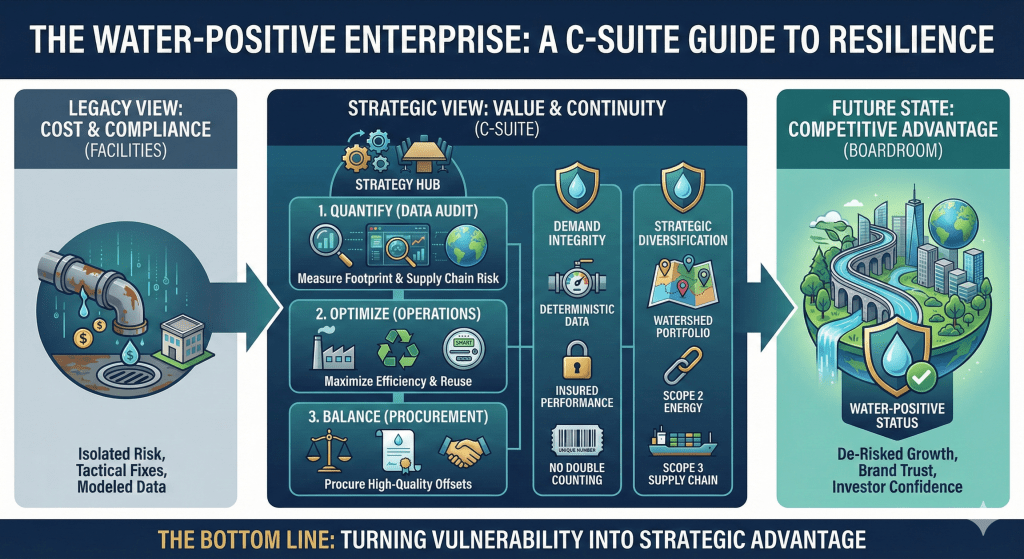
For years, water was delegated to the facilities team, a line item to be managed, not a strategy to be led.
That era is over. Today, water is a strategic chokepoint. It is a stranded asset risk for the CFO, a supply chain bottleneck for the COO, a reputation driver for the CMO, and a “license-to-operate” imperative for the CEO.
Moving from “compliance” to “water-positive” isn’t just about sustainability; it is about securing business continuity in a volatile world.
But how does a leadership team execute this without falling into the greenwashing traps of early voluntary carbon markets? Here is a strategic framework for building a defensible, high-impact water portfolio.
1. The Operational Hierarchy
Start by establishing operational discipline. A credible C-Suite water strategy follows a strict hierarchy of needs:
- Quantify the Risk (The Data): You cannot manage what you don’t measure. The first step is a rigorous audit of your direct operational footprint and your supply chain’s embedded water risk.
- Optimize the Asset (The Operations): Maximize efficiency within your four walls. Fix leaks, implement reuse systems, and optimize processes. This drives immediate ROI and operational resilience.
- Balance the Ledger (The Procurement): For the footprint you cannot eliminate, procure high-quality water certificates to balance the impact and achieve a water-positive status.
2. Demanding Integrity in Offsets
The biggest risk to the C-Suite is reputation. Early carbon markets taught us that “intent” isn’t enough; you need proof. When approving water investments, leadership must demand more than modeled estimates.
A boardroom-ready water certificate requires:
- Deterministic Data: Metered, verified evidence of water saved or replenished. If it isn’t measured, it isn’t a verifiable asset.
- Performance Insurance: Is the outcome guaranteed by an investment-grade insurer? Insurance converts a project’s “promise” into a deliverable asset, protecting the company from non-delivery risk.
- Clear Additionality: Would this project have happened anyway? If yes, your investment didn’t create new impact.
- Prevention of Double Counting: Ensure the water benefit is uniquely registered and permanently retired on your behalf. If the same drop of water is claimed by two companies, the asset—and your claim—is worthless.
3. Strategic Diversification: The Portfolio Approach
A prudent executive wouldn’t bet the company’s future on a single vendor or a single market. Your water portfolio requires the same risk management.
Water is intensely local. A million gallons saved in wet area like Seattle does nothing to de-risk operations in a water stressed region like Phoenix.
Diversify your portfolio across the high-stress watersheds relevant to your specific operations, data centers, and key suppliers. This spreads risk and ensures your investments build resilience exactly where your business needs it most.
4. Addressing the Hidden Iceberg: Scope 2 & Scope 3
Most corporate water strategies stop at the factory gate (Scope 1). But for most enterprises, direct usage is less than 10% of the risk. The real vulnerability lies in the supply chain.
- Scope 2 (The Energy Link): If your data centers run on thirsty power generation (fossil fuels, nuclear), your digital operations have a massive physical water footprint.
- Scope 3 (The Supply Chain): This is the silent killer. It’s the water used to grow your raw materials or manufacture your semiconductors. If your Tier 1 suppliers are in high-stress basins, their drought is your downtime.
You will not become a truly resilient enterprise if you are ignoring the water embedded in your energy infrastructure and your supply chain. High-quality water certificates allow you to address these indirect impacts effectively, balancing the water “consumed” by your suppliers with water “returned” to those same stressed ecosystems.
The Bottom Line: Building a water-positive enterprise is about de-risking the future. By treating water as a strategic asset rather than a utility bill, the C-Suite turns a potential vulnerability into a competitive advantage.