
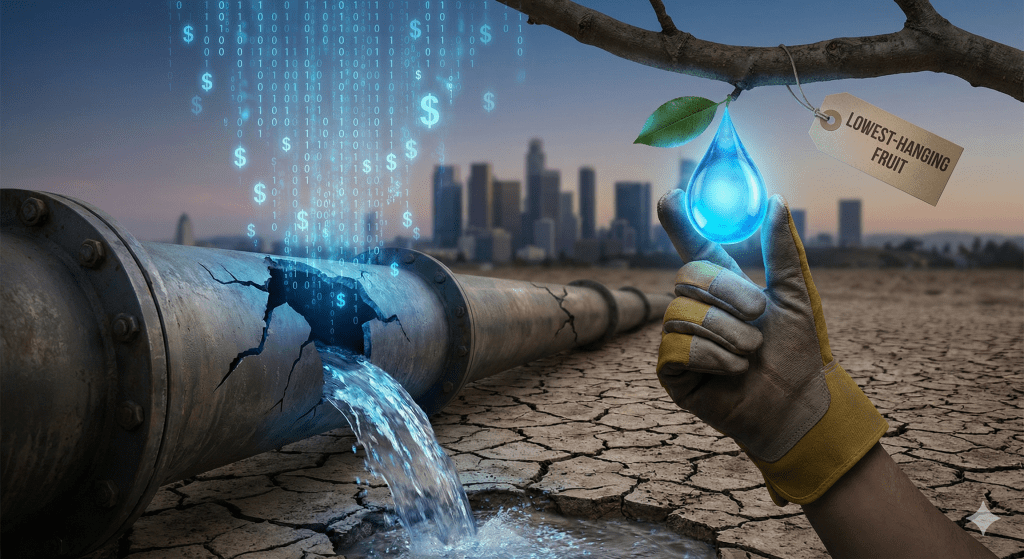
Imagine a manufacturing business that produces high-quality goods, but every day, 30% of its inventory simply vanishes on the way to the customer. No one pays for it, but the business still paid to make it, package it, and ship it.
No CEO would accept this. Yet, this is the daily reality for water utilities around the globe.
We hear a lot about the desperate need for water infrastructure investment. We talk about building massive new reservoirs, high-tech desalination plants, and interstate water pipelines. These are flashy, expensive, decade-long projects.
But while we focus on increasing supply, we are ignoring a massive, silent crisis on the demand side. We are ignoring “Non-Revenue Water.”
Fixing it isn’t glamorous. It doesn’t involve ribbon-cuttings at massive new dams. But addressing Non-Revenue Water is, without question, the lowest-hanging fruit in the water sector. It is the most financially responsible, environmentally sound, and fastest way to improve global water security.
Here is why.
What is Non-Revenue Water (NRW)?
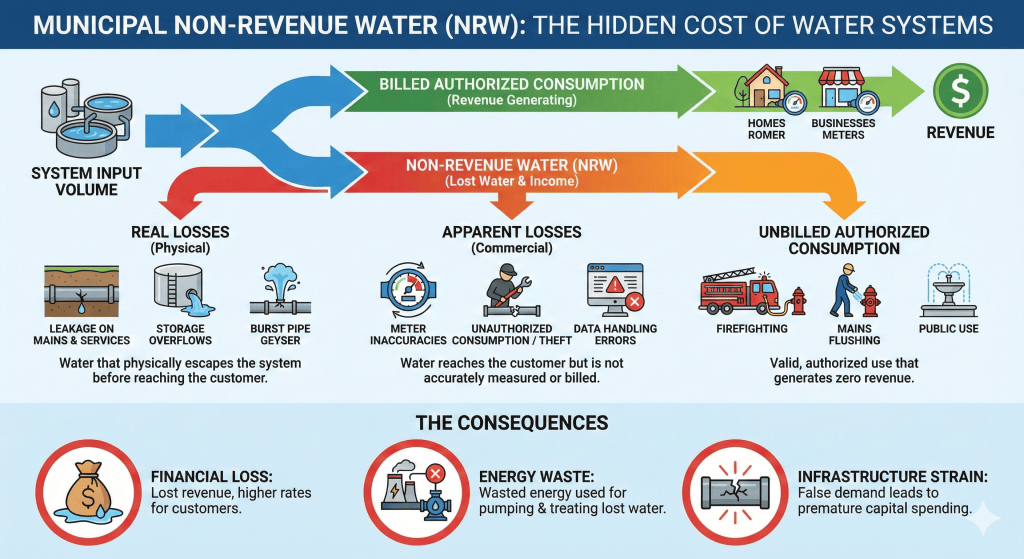
Simply put, Non-Revenue Water is water that a utility treats and pumps into the network but which is never billed to a customer. It is practically invisible, but its impact is staggering. The World Bank estimates that globally, NRW costs utilities some $14 billion every year.
NRW generally falls into two buckets:
- Physical Losses (The Leaks): Water escaping through aging pipes, broken joints, and fractured mains before it ever reaches a home or business.
- Commercial Losses (The “Paper” Losses): Water that reaches the customer but isn’t paid for due to inaccurate meters, data handling errors, or outright theft via illegal connections.
In many developing nations, NRW rates exceed 50%. Even in developed regions like North America and Europe, it is not uncommon for cities to lose 15% to 30% of their treated water before it reaches a faucet.
Why NRW is the “Lowest-Hanging Fruit”
When facing water scarcity, the instinct is often to find more water. But before we spend billions trying to squeeze more water from a stressed environment, we must plug the holes in the bucket we already have.
Here is why tackling NRW is the logical first step for infrastructure investment.
1. The Unbeatable Return on Investment
Every gallon of non-revenue water carries a sunk cost. The utility has already paid for the electricity to pump it from the source, the chemicals to treat it to drinking standards, and the energy to pressurize it into the distribution network.
When that water leaks into the ground, that money is wasted.
Investing in NRW reduction—through leak detection sensors, pressure management, and smart metering—offers an almost immediate payback. It is far cheaper to save a gallon of existing treated water than it is to permit, build, and operate facilities to generate a new gallon.
2. The Energy-Water Nexus
Water and energy are inextricably linked. Water treatment and distribution are incredibly energy-intensive processes. In many municipalities, water infrastructure is the single largest consumer of electricity.
When we allow treated water to leak, we aren’t just wasting water; we are wasting the immense amount of energy used to process it. Reducing NRW is a climate strategy. By tightening the distribution network, we reduce carbon emissions associated with pumping and treatment instantly.
3. Technology Has Changed the Game
Twenty years ago, finding leaks was a manual, acoustic process—essentially walking around listening to the ground with expensive stethoscopes. It was slow and reactive.
Today, NRW reduction is a data science problem. The “fruit” hangs lower now because the ladder is better.
We now have affordable IoT sensors that monitor pressure and flow in real-time. We have artificial intelligence that can analyze acoustic data from fire hydrants to pinpoint small fractures before they become catastrophic main breaks. We have Advanced Metering Infrastructure (AMI) that detects customer-side leaks instantly.
We no longer have to guess where the water is going. We know.
4. Buying Time and Building Trust
Perhaps most importantly, aggressively tackling NRW buys cities time.
If a city is facing a projected water shortage in 2035 based on current growth, cutting NRW by 15% might push that shortage date back to 2050. That is fifteen extra years to plan major capital projects properly rather than rushing them in a panic.
Furthermore, it builds public trust. It is very difficult for a utility to ask ratepayers to fund expensive new supply projects or adopt conservation measures when the public knows the utility itself is losing a quarter of its product to inefficiency. Fixing the utility’s own house first is essential for political capital.
The Efficiency First Mandate
We cannot build our way out of the water crisis solely through new supply. The environmental and financial costs are too high.
While the allure of mega-projects is strong for politicians seeking legacy achievements, the responsible path forward starts underground, in the unglamorous work of tightening bolts, repairing pipes, replacing sensors, and analyzing flow data.
Before we look for new water, let’s ensure we are actually delivering the water we already have. Non-Revenue Water is the low-hanging fruit, and it’s time we started picking it.