
Texas voters approved a dedicated water fund in 2025, and the Texas Water Development Board expects that money to reach its financial assistance programs in fall 2029 (TWDB). For a utility with pipe failing now, 2029 is a long wait. A utility that needs to replace aging pipe usually has three places to find the money: its own ratepayers, its own borrowing, and state and federal programs. The federal piece faces real pressure right now.
The size of the gap
The American Society of Civil Engineers and the Value of Water Campaign estimated that U.S. water infrastructure needs in 2024 would total $270 billion, against $179 billion in projected spending. That leaves a gap of $91 billion for a single year. The same study projects a cumulative gap of more than $2 trillion by 2043 (Bridging the Gap, 2024).
ASCE notes that utilities pay operating and maintenance costs mainly through customer rates and rely on state and federal financing and grant programs to support infrastructure upgrades. Those programs matter most for projects a utility cannot finance on its own, especially in small and disadvantaged communities.
How the State Revolving Funds work
The Clean Water and Drinking Water State Revolving Funds are the main federal channels for water infrastructure. Congress appropriates capitalization grants to states. States add a match and make low-interest loans, and in some cases grants or forgivable loans, to utilities. As loans are repaid, the money revolves back into the fund and can be lent again.
The 2021 Infrastructure Investment and Jobs Act added a large temporary layer on top of the annual appropriations. ASCE reports that the law reauthorized the Drinking Water SRF at $15 billion over five years and appropriated an additional $31 billion for capitalization, lead service line removal, and emerging contaminants (ASCE 2025 Report Card). Those supplemental appropriations run through fiscal year 2026 (WASDA).
Where the money stands
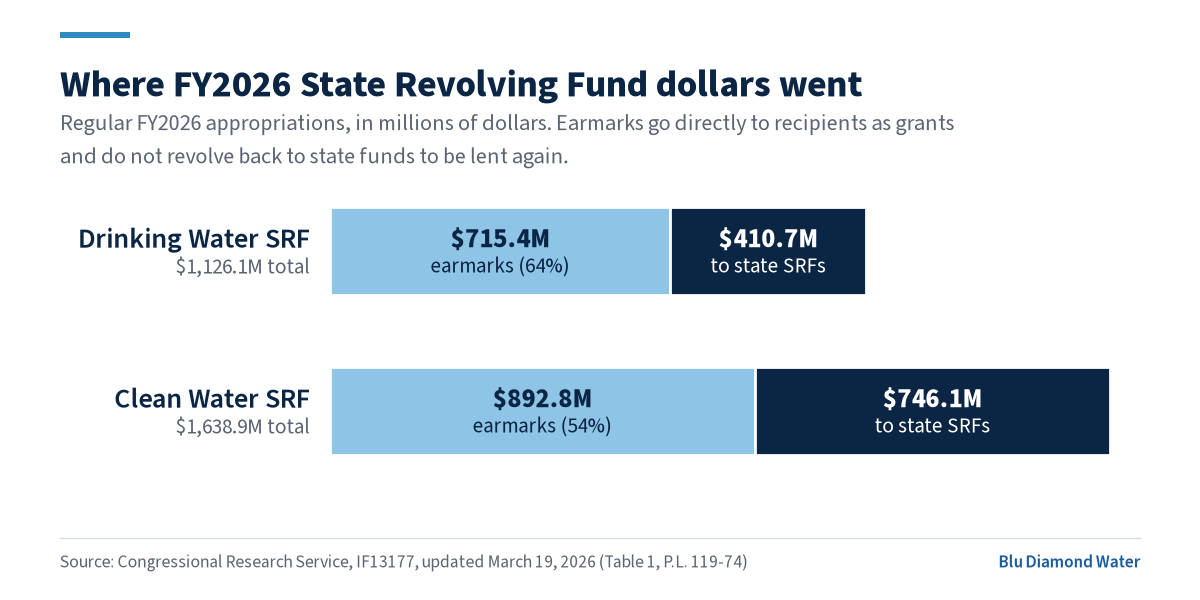
FY2026. Congress appropriated $1,126.1 million for the Drinking Water SRF. According to the Congressional Research Service, the act dedicated 64% of that amount, $715.4 million, to congressionally directed spending, often called earmarks. It dedicated 54% of the Clean Water SRF appropriation, $892.8 million, the same way (CRS IF13177).
Earmarks fund real projects in real communities. They also change how the program works. CRS explains that EPA distributes these amounts directly to recipients as grants instead of to state revolving funds, which reduces the amount that revolves back to the states and is available to lend again. ASCE reports that between FY2022 and FY2023, more than $1 billion went from the Drinking Water SRF to earmarks, which cut capitalization grants to states by nearly 45%.
FY2027. In June, the House Appropriations Committee approved an Interior-Environment bill that would cut SRF funding from FY2026. Under the House committee’s bill, the Drinking Water SRF would receive $910 million, down from $1.126 billion. The Clean Water SRF would receive $1.192 billion, down from $1.639 billion. Together, the two funds would receive $663 million less, falling from $2.765 billion to $2.102 billion (Water Finance & Management, June 12, 2026). The same report notes that the Senate has rejected House cuts to these programs in recent years.
Those are House figures, and final FY2027 funding has not been set. A continuing resolution signed September 2 funds the government at FY2026 rates through December 11, 2026, unless Congress extends or replaces it (Congressional Research Service).
State programs help, on their own schedule
Some states have created major new funding sources. Texas voters approved Proposition 4 on November 4, 2025, with 70.42% of the vote (Texas Legislative Reference Library). The amendment dedicates the first $1 billion of state sales and use tax revenue above $46.5 billion each fiscal year to the Texas Water Fund, starting September 1, 2027, and running through August 31, 2047.
That is a significant long-term commitment. The timing matters for any utility with an urgent need. The Texas Water Development Board’s Proposition 4 FAQ projects that the new money will reach TWDB financial assistance programs in fall 2029, contingent on revenue and legislative appropriation.
What this means for a utility with a project ready to go
Picture a utility with a leak repair program engineered and ready. It has three choices. It can raise rates, which is politically difficult and falls hardest on low-income households. It can apply for state and federal funds and wait for a competitive award. It can defer the project and keep losing treated water.
Each of those choices leaves the community worse off. A fourth option has started to appear: private sponsors who want a credible local water benefit and are willing to help pay for it.
How a corporate commitment gets the project built sooner
Sponsors can use a milestone contract: the company pays for a defined project in stages as the work progresses and receives Certificates only after the measured water benefit is verified. For larger programs, a sponsor can also use a structure that works more like a power purchase agreement: a company commits to buy Certificates each year over a fixed term, and that commitment helps financial partners provide upfront capital so construction can start sooner. In either structure, results are metered and independently verified, and insurance through Blu Clarity backs Certificate delivery for a defined period after validation.
Private funding works alongside public programs. A corporate commitment can pay for the engineering that makes a project ready for a state award, fund the portion public money will not cover, or carry a project until public money arrives. The utility gets its infrastructure sooner without raising rates to pay for it. The company gets a verified local water benefit it can report with confidence.
We explained the structure in more detail in How Blu Diamond Accelerates Financing for Water Infrastructure Before It’s Built.
For the company, the commitment shows up as a predictable annual purchase instead of a large one-time capital outlay, which is often far easier to approve internally.
What to do now
If your company has water goals or operates in a community with an aging water system:
- Ask the local utility what is on its deferred list. Many utilities have projects that are engineered and waiting on funding.
- Learn the public funding calendar. Know which state and federal applications the utility has pending, so your contribution complements them.
- Agree on who claims which benefit. When public and private money fund the same project, decide in writing how the benefits are allocated so no one counts the same gallon twice.
- Insist on measurement and verification. A defined baseline and metered results protect the company’s claim and give the utility better data.
Interested in funding a water project in a community where you operate? Contact Blu Diamond Water.
Sources
- American Society of Civil Engineers and Value of Water Campaign, “Bridging the Gap: The Power of Investment in Water,” 2024: https://uswateralliance.org/wp-content/uploads/2024/05/Bridging-the-Gap%E2%80%94The-Economic-Benefits-of-Investing-in-Water.pdf
- American Society of Civil Engineers, 2025 Report Card for America’s Infrastructure, Drinking Water: https://infrastructurereportcard.org/cat-item/drinking-water-infrastructure/
- WASDA, “America’s Water Infrastructure Needs: Planning Beyond IIJA” (fact sheet): https://wasda.memberclicks.net/assets/WASDAmeet/Summits/FACT%20SHEET%20-%20Water%20Infrastructure%20Funding%20%28final%29.pdf
- Congressional Research Service, “FY2026 Appropriations for U.S. Environmental Protection Agency (EPA) Water Infrastructure Programs,” IF13177: https://www.congress.gov/crs-product/IF13177
- Water Finance & Management, “House advances spending bill with proposed 16% SRF cut,” June 12, 2026: https://waterfm.com/house-advances-spending-bill-with-proposed-16-srf-cut/
- Congressional Research Service, “Department of Homeland Security Appropriations: FY2027 State of Play,” R49427, September 30, 2026 (continuing resolution status, P.L. 119-103): https://www.everycrsreport.com/files/2026-09-30_R49427_a2cdcfc69757107876ba1f7270bfe4c95296bae3.pdf
- Texas Legislative Reference Library, Proposition 4 (HJR 7) election details, November 4, 2025: https://lrl.texas.gov/legis/billsearch/amendmentdetails.cfm?amendmentID=729&billNumberDetail=7&billSuffixDetail=&billtypeDetail=HJR&legSession=89-0
- Texas Water Development Board, “Proposition 4 and Texas Water Fund Frequently Asked Questions,” September 2025: https://www.twdb.texas.gov/financial/programs/TWF/doc/Proposition_4_FAQ.pdf