

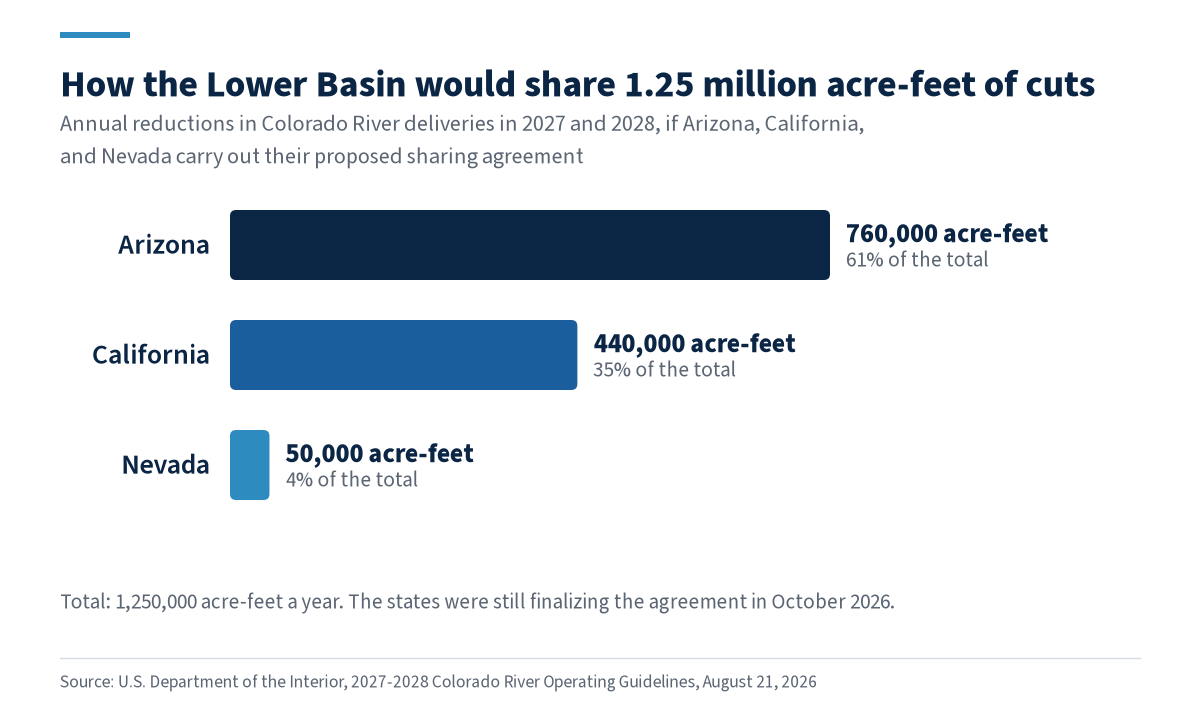
On August 21, 2026, the Department of the Interior signed the operating guidelines for the Colorado River for 2027 and 2028. The new rules took effect October 1, according to KJZZ and NPR. For Lake Mead, deliveries to the Lower Basin states drop by 1.25 million acre-feet in calendar year 2027, and the guidelines provide for the same reduction in 2028 (Interior).
Arizona, California, and Nevada have proposed a sharing agreement to divide those cuts. If they carry it out, Interior lists the annual reductions as 760,000 acre-feet for Arizona, 440,000 for California, and 50,000 for Nevada. The guidelines also call on the Lower Basin states to voluntarily conserve and store at least 700,000 acre-feet over the two years. As of October 1, the three states were still finalizing their agreement, according to KJZZ, and once negotiators sign it, the Arizona Legislature also has to approve it. Arizona’s cuts become official on January 1, 2027, according to KJZZ. NPR summarized the effect as Arizona, California, and Nevada taking about 20% less water.
The backdrop is a drought that Interior says has lasted 26 years. Interior reports that the winter of 2025 to 2026 produced the lowest observed snowpack on record, and that the combined contents of Lake Powell and Lake Mead have not been this low since before Lake Powell began filling in 1963.
When supply shrinks, every utility in the basin looks for water it can count on. Some of the most reliable water available is water the utility has already treated.
The water a utility has already paid for
A utility collects water, treats it, and pumps it into the distribution system. Some of it leaks out before it reaches a customer’s meter. Every gallon lost that way carries the cost of treatment and pumping with nothing to show for it.
That lost water is a supply source. Recovering it takes no new water right or pipeline. Crews find the leaks, repair the pipe, and confirm the repair held, all inside the existing system, which is why leak repair can often move faster than new supply projects.
Reuse is the other local supply
The second source a utility already controls is its wastewater. Treated to the right standard, it can serve irrigation, industrial cooling, and other uses that would otherwise draw on potable supply.
Industrial users in the basin already plan around it, and some large manufacturers now build plants to treat and reuse their own process water on site.
Municipal reuse works on the same principle at a different scale. Every gallon of reclaimed water that serves a nonpotable need is a gallon of drinking water left in the system.
Why this matters for shortage planning
Shortage plans usually start with demand cuts: restrictions on outdoor watering, tiered pricing, conservation campaigns. Those are necessary, and they ask residents and businesses to use less.
Water loss recovery and reuse take a different route. They increase the water available to the community without asking customers to change behavior, and they keep producing benefits after the shortage eases. A utility that cuts its losses also strengthens its case when it asks ratepayers to conserve, because it can show it fixed its own system first.
Interior’s announcement points the same way. It says the department will work with basin states and tribes on water supply projects, including desalination and advanced water treatment, water movement and exchanges, and efficiency. The agreements and federal programs will take time. Local loss recovery and reuse can start sooner.
What a corporate partner can do
Large water users in Arizona, Nevada, and California have a direct stake in how the region handles these cuts. Many of them also have sustainability commitments that call for local water benefits. A shortage year is a practical moment to put those two interests together.
If your company operates in the Lower Basin, consider:
- Asking the local utility what it would fix first. Many utilities have leak repair, meter, and reuse projects ready that lack funding. Starting with their list puts your contribution where the system needs it.
- Prioritizing projects that add usable supply. Leak repair and reuse change the volume of water available. Revenue-only fixes are valuable to the utility and should be described accurately.
- Insisting on measurement. A baseline before construction and metered results afterward let you report a benefit you can defend, and give the utility data it can use in its own planning.
- Planning for the long term. The 2027 and 2028 guidelines sit inside a ten-year decision framework, and the operating rules beyond 2028 are still unresolved. A project that keeps delivering for years is worth more than a one-time gesture.
What the utility needs from a partner
A utility in a shortage year is busy. Its staff are updating drought plans, talking to customers about restrictions, and negotiating with wholesale suppliers. A partner that adds to that workload will get a polite hearing and little else. A partner that makes the work easier will get a project.
A few practices help:
- Report in the units the utility plans in. Western utilities plan in acre-feet. If the project’s benefit is reported the same way, the utility can drop it straight into its supply planning.
- Align the schedule with the shortage plan. Ask when the utility’s next drought stage decision or supply update is due, and design the project timeline so results are measurable before then.
- Take on the data burden. Fund the meters, the data collection, and the verification, so the utility receives clean results without assigning staff to produce them.
- Leave the asset with the utility. Pipe, meters, and treatment equipment should belong to the system that operates them, with a clear maintenance plan once the project’s funding period ends.
A project built this way helps the utility meet its own shortage obligations, which makes it far easier to approve.
Where Blu Diamond fits
Blu Diamond Water funds and delivers water loss recovery and reuse projects that local utilities have prioritized. We start from a metered baseline and have an independent party confirm the results, which gives the utility numbers it can use in its own shortage planning. Our non-revenue water explainer covers why loss recovery is often the first place to look.
If your company uses water in the Colorado River Basin and wants to fund a local, verified water benefit, contact Blu Diamond Water.
Sources
- U.S. Department of the Interior, “Interior Department Finalizes Plans for 2027-2028 Colorado River Operations,” August 21, 2026: https://www.doi.gov/pressreleases/interior-department-finalizes-plans-2027-2028-colorado-river-operations
- KJZZ, “New Colorado River rules start today, but questions linger about Arizona water cutbacks,” October 1, 2026: https://www.kjzz.org/politics/2026-10-01/new-colorado-river-rules-start-today-but-questions-linger-about-arizona-water-cutbacks
- NPR, “New rules for sharing the Colorado River start today,” October 1, 2026: https://www.npr.org/2026/10/01/nx-s1-5980083/new-rules-for-sharing-the-colorado-river-start-today