

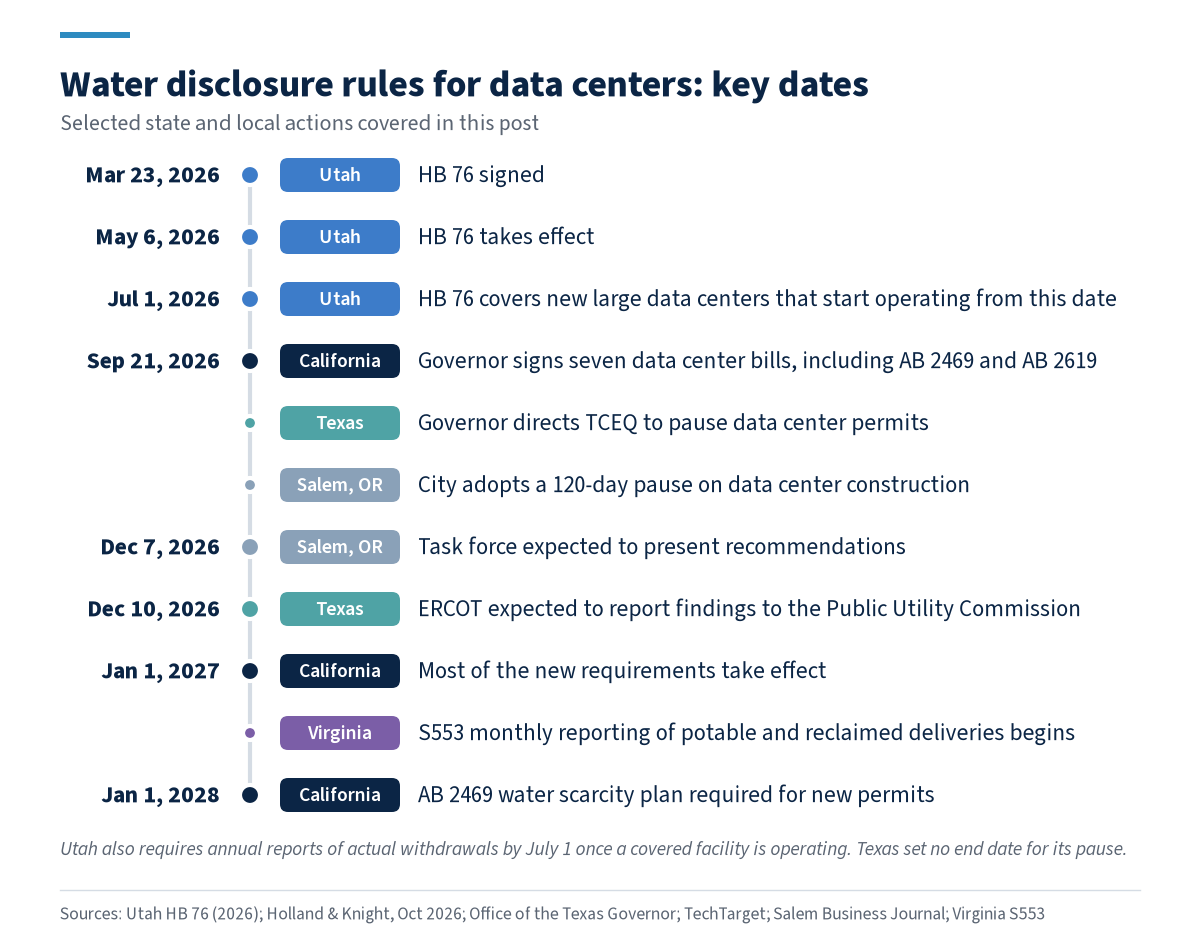
On September 21, 2026, two of the largest data center markets in the country changed their rules on the same day.
In California, Governor Newsom signed seven data center bills. Two of them, AB 2469 and AB 2619, tie local permits and business licenses to water information that many projects have never had to produce in a single place. In Texas, Governor Abbott directed the Texas Commission on Environmental Quality to pause the issuance of all permits related to data center projects “until ERCOT completes its review.” The same letter directs the Texas Water Development Board to join ERCOT’s audit to gather water use information.
If you develop or operate data centers, water data now sits on the critical path to a permit in more places than it did a year ago. Most of what these laws ask for is information a well-run project should already have.
What changed in California
AB 2469 prohibits a city or county from approving a permit for a new data center, or for an expansion that increases maximum peak water use, unless the applicant provides:
- A water supply assessment under the California Water Code.
- Projected water use and water efficiency measures.
- Workforce disclosures.
- Beginning January 1, 2028, a water scarcity plan with measures for each U.S. Drought Monitor category, from abnormally dry through exceptional drought. The bill lists examples such as staged withdrawal reductions, nonessential use curtailment, recycling and reuse, and thermal load reductions.
The applicant must also assume the full cost of any water conveyance, treatment, storage, or distribution improvements that the water supplier determines are needed to serve the project.
AB 2619 works through the business license. Before applying for an initial license, a data center owner or operator must give its water supplier a good-faith estimate of expected water use, the anticipated source, and projected volumes for the maximum day, maximum month, and average year. The same estimate goes on the license application. At each renewal, the operator reports the prior year’s actual water use, total and direct, by source (potable, nonpotable, or recycled), along with the cooling system type. Both reports are made under penalty of perjury.
According to Holland & Knight’s summary of the package, most of the new requirements take effect January 1, 2027. The firm also notes that none of the seven laws bans data centers or establishes a moratorium, and that the laws “codify and make enforceable the ‘bring, buy, or build’ commitments that many large-scale data center developers already bring to the table.”
What changed in Texas
The Texas directive asks for information first. Governor Abbott’s September 21 letter to TCEQ directs the agency to pause the issuance of all permits related to data center projects until ERCOT completes its review. The ERCOT and Texas Water Development Board audits seek information on planned facilities’ electricity use, water use, and community impact. Data center projects must “complete the ERCOT and TWDB audits,” the governor wrote.
The letter sets no end date for the pause. ERCOT expects to report its findings to the Public Utility Commission of Texas on December 10, according to TechTarget.
The state’s starting point is thin data. The Texas Tribune reported that as few as 28% of data centers responded to the Texas Water Development Board’s mandatory water use survey over the last three years. The board uses that survey to plan how much water the state will need.
Other states have taken similar steps
Utah’s HB 76, signed March 23, 2026, took effect May 6, 2026. It applies to new large data centers, defined as facilities that withdraw 75 acre-feet or more per year and begin operations on or after July 1, 2026. Between 360 and 90 days before construction begins, the operator must tell the local water provider about anticipated consumption and report estimated withdrawals, discharge treatment plans, and any planned water reuse to the state Division of Water Rights. After operations begin, the operator reports actual withdrawals and conservation efforts every year by July 1. The state publishes withdrawal data, with protections for information treated as proprietary.
Virginia’s S553, effective January 1, 2027, has water suppliers that already report their withdrawals list the potable and reclaimed water they deliver to permitted data centers each month, with reclaimed water reported separately.
Local governments write rules too. Salem, Oregon, adopted a 120-day pause on data center construction on September 21 while it drafts regulations on water consumption and other effects. Its task force expects to present recommendations December 7, according to the Salem Business Journal.
What the new rules have in common
Read side by side, these laws ask four questions:
- How much water will you use, and from what source? Asked before the permit or license, and in some states before construction.
- How much did you actually use? Asked every year, by source.
- What happens in a drought? California wants a staged plan tied to drought categories.
- Who pays for the water infrastructure you need? California assigns that cost to the applicant.
These questions aren’t hostile to data centers. Each one is a question a utility planner has to answer anyway. The laws move the answers earlier and make them public or sworn.
A readiness checklist
1. Build the water estimate with the utility, early
Treat the water estimate as an engineering deliverable with an owner and a review date, alongside your interconnection studies. Share it with the water supplier before you file anything. A supplier that has seen your numbers early is far more likely to describe them accurately to a council or a state agency.
2. Meter by source from day one
AB 2619 asks for actual use split by potable, nonpotable, and recycled water. Virginia separates potable from reclaimed. If your metering only reports a single site total, you’ll have to reconstruct those numbers later from bills and estimates. Install meters that report each source separately, and keep the data at the interval your cooling design actually varies.
3. Write the drought plan before you need it
California’s water scarcity plan is not due until 2028, and it’s still worth drafting now. A plan that shows what the facility will do at each drought stage gives local officials a concrete answer to the most common question they hear from residents.
4. Budget for the infrastructure the supplier says you need
California makes the applicant responsible for the full cost of required water improvements. Ask the supplier early what those improvements are, get a cost range, and carry it in the pro forma. A late surprise here costs more than the infrastructure itself.
5. Show what you leave behind
Disclosure tells a community what a project takes. It doesn’t tell them what the project gives back. The projects that move through local approvals most smoothly can point to a specific improvement in the local water system, chosen by the utility, such as leak repair that recovers treated water or a reuse project that frees potable supply.
6. Get the benefit verified
A water benefit that appears only in a press release will not carry much weight in a sworn filing or a public hearing. Establish a metered baseline before construction, tie each repair or installation to a location and an acceptance record, and have an independent party confirm the measured change. That record is what lets you state the benefit with confidence when someone asks.
Where Blu Diamond fits
Blu Diamond Water funds and delivers water projects that utilities have already identified as priorities, and documents the outcome to a standard built for scrutiny. Each project starts from a metered baseline and ends with measured results that an independent party has checked, so the benefit you describe in a permit file or a disclosure rests on data instead of estimates.
If you face California’s 2027 requirements, the Texas audits, or a site anywhere water is a local concern, line up a community water project before the permit application. Our earlier guide, Don’t Let Water Kill Your CapEx, covers the broader permitting picture.
Questions about water reporting or a community water project for your site? Contact Blu Diamond Water.
Sources
- California Legislative Information, AB 2469 (Chapter 436, Statutes of 2026), approved September 21, 2026: https://leginfo.legislature.ca.gov/faces/billTextClient.xhtml?bill_id=202520260AB2469
- California Legislative Information, AB 2619 (Chapter 437, Statutes of 2026), approved September 21, 2026: https://leginfo.legislature.ca.gov/faces/billTextClient.xhtml?bill_id=202520260AB2619
- Holland & Knight, “California’s 2026 Data Center Laws: What You Need to Know,” October 2026: https://www.hklaw.com/en/insights/publications/2026/10/californias-2026-data-center-laws-what-you-need-to-know
- Texas Tribune, “Gov. Greg Abbott broadens moratorium on data center approvals to include environmental permits,” September 21, 2026: https://www.texastribune.org/2026/09/21/texas-data-center-moratorium-water-energy/
- Texas Tribune, “Texas could penalize data centers for not reporting water use,” September 14, 2026: https://www.texastribune.org/2026/09/14/texas-data-centers-abbott-water-survey-enforcement/
- Office of the Texas Governor, letter to TCEQ Executive Director Kelly Keel, September 21, 2026: https://gov.texas.gov/uploads/files/press/TCEQ_Data_Center.pdf
- TechTarget, “TCEQ’s data center permit freeze may reach beyond ERCOT review,” September 24, 2026: https://www.techtarget.com/it-infrastructure/news/366651196/TCEQs-data-center-permit-freeze-may-reach-beyond-ERCOT-review
- Utah Legislature, H.B. 76 Data Center Water Transparency Amendments, Enrolled Copy (signed March 23, 2026; effective May 6, 2026): https://le.utah.gov/Session/2026/bills/enrolled/HB0076.pdf
- Virginia Acts of Assembly, 2026 Session, S553: https://lis.blob.core.windows.net/files/1214533.PDF
- Salem Business Journal, “Salem Data Center Moratorium Pauses Construction,” September 2026: https://salembusinessjournal.org/salem/technology/salem-data-center-moratorium-2