We’ve been thinking a lot about water infrastructure as we go deeper into data center work, and I recently came across a World Bank blog that put the challenge into sharp perspective.
Water underpins everything we rely on in modern society: energy, industry, housing, and increasingly the digital infrastructure that powers AI. But it remains one of the most underfunded systems in the world.
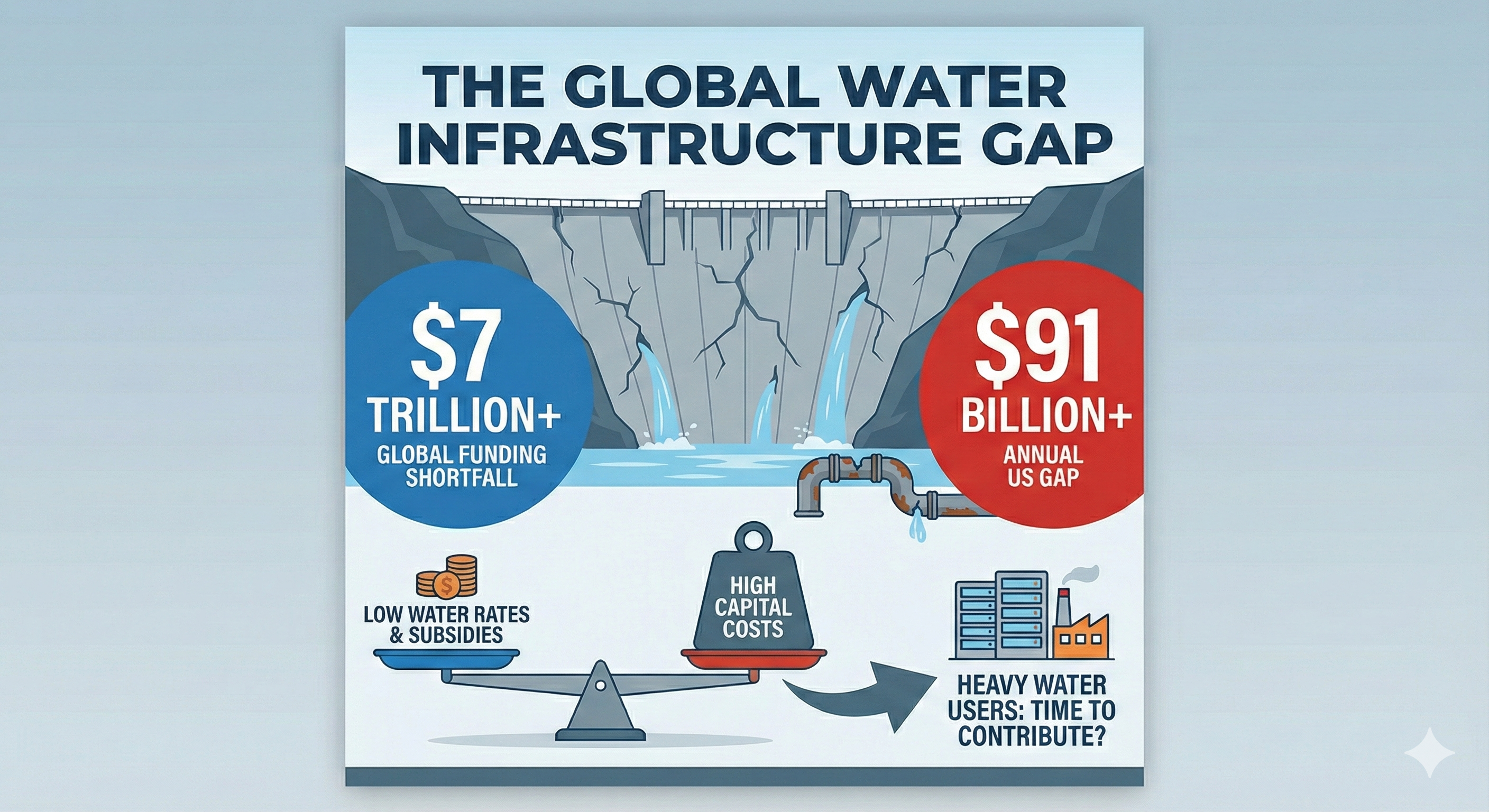
The numbers are staggering. The World Bank estimates a $7 trillion global funding gap for water infrastructure by 2030, and the U.S. alone is short $91 billion every year.
The blog highlighted why this gap has persisted for so long. Water infrastructure is expensive, but water itself is priced relatively low because public financing has historically subsidized the true cost. Private investors, on the other hand, need long-term offtake agreements that provide a return on capital, and most water contracts simply don’t. With constrained pricing, the economics don’t pencil out, so private capital stays at the margins.
As a result, fewer than 2% of water projects attract private investment. The rest rely on public budgets, which are already stretched thin.
That leaves utilities with limited choices: delay critical upgrades or raise rates. And unless heavy industrial and commercial water users help share these costs, the burden ultimately shifts to households through higher utility bills.
This is more than an economic issue—it’s a growth constraint. The systems that treat, deliver, and recycle water were not designed for today’s industrial load or the rate at which new capacity is being added. Manufacturing, semiconductors, and now AI infrastructure are all putting new demands on water systems that weren’t built for this moment.
For those of us planning large-scale compute infrastructure, this is becoming increasingly relevant. Power has dominated the conversation, but in many regions water availability and affordability will shape site strategy and timelines just as much.
If we expect the next wave of digital and industrial growth to be sustainable, the financing model for water infrastructure has to evolve. Ratepayers alone cannot close a multi-trillion-dollar gap.